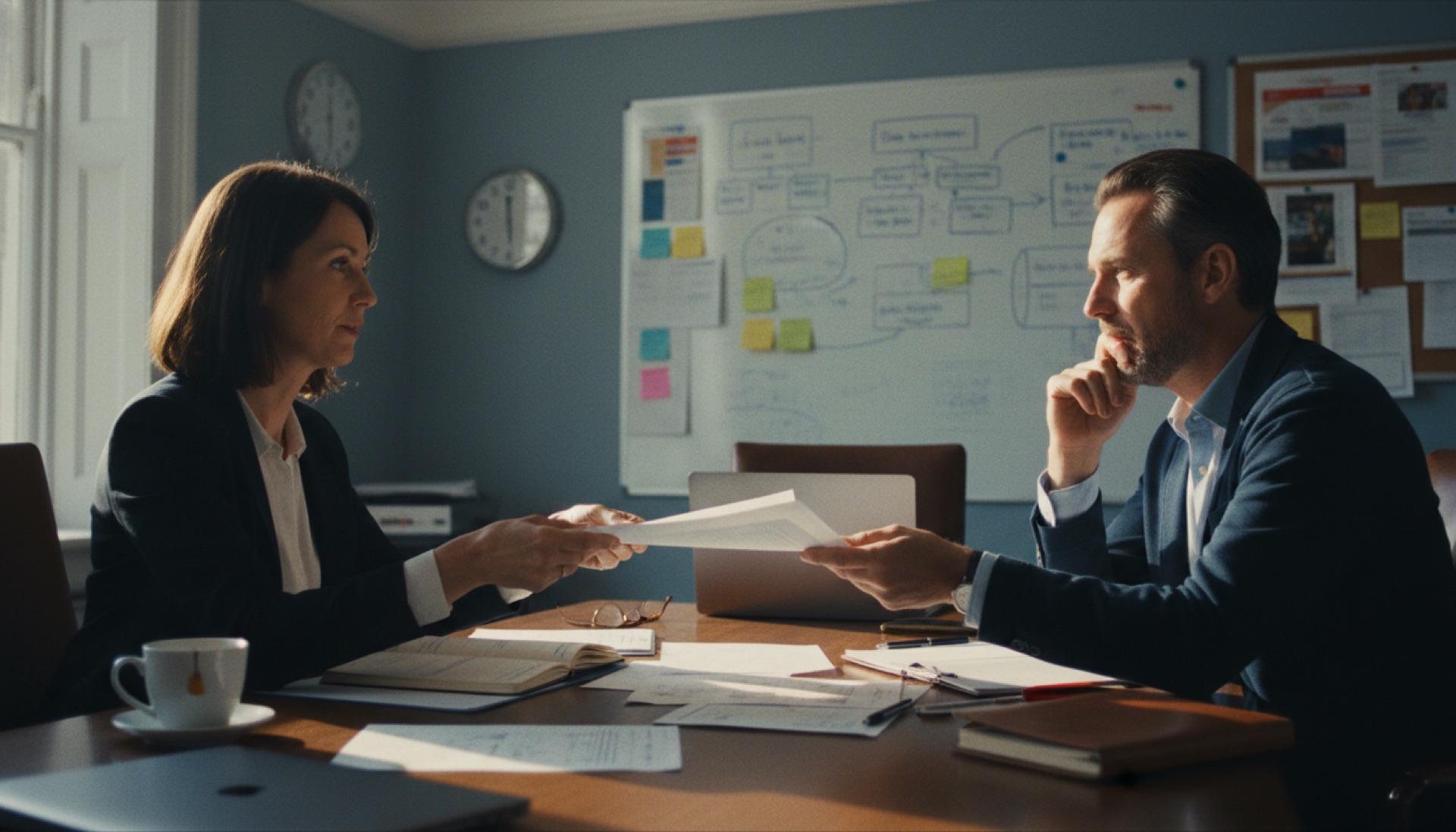
The call comes at 7pm on a Friday. The operations manager needs approval on a supplier payment. It’s well within budget. She’s worked with this supplier for two years. But no one on the team is confident they’re authorised to say yes without you, so they’ve called.
That scenario isn’t unusual. Research from the Federation of Small Businesses found that 76% of UK small business owners work regularly during holidays, with many citing the belief that the business can’t function without them as the primary reason. The pattern points to something structural rather than a personal failing.
If you’re asking whether your business is too dependent on you, there’s a quick way to find out. Imagine two weeks away with your phone off. What breaks first? If sales stall because you close them, routine payments wait for your sign-off, and the team parks decisions until you’re back, your business relies too much on its owner. One of those is a gap. All three is a structure.
The technical name for that structure is owner dependency, sometimes written as owner-dependence. It’s worth understanding precisely what it means, where it shows up, and in which situations it genuinely matters less.
What does owner-dependence actually mean?
Owner-dependence describes a situation where the continued success of a business rests on one person’s presence, relationships, or decisions, almost always the founder. Buyers, lenders, and insurers treat it as concentration risk because the revenue, operational knowledge, and day-to-day capability that hold the firm together are tied to one individual rather than embedded in systems and a team.
The term key-person risk appears across insurance policies, acquisition documents, and lender credit assessments. When any of those parties assess the business, they’re asking the same question you should be asking yourself. What happens here if one specific person is no longer available?
KMF Business Advisors, an M&A advisory firm that analyses owner-dependence across small business transactions, identifies 18 specific warning signs. They range from the founder personally closing sales and approving pricing, to the founder being the sole point of contact for key clients and the only person with access to critical systems.
What does owner dependency cost?
The impact goes further than personal stress. Owner-dependence directly reduces what a buyer will pay and what a lender will offer. UK M&A brokerage analysis suggests that businesses with transferable systems and an independent management team can achieve EBITDA multiples 0.5 to 1.0 times higher than comparable founder-centric firms, because acquirers price in lower continuity risk. The Exit Planning Institute’s State of Owner Readiness research puts the wider cost starkly. Between 70% and 80% of businesses put up for sale never find a buyer, and owner dependency sits consistently among the leading reasons deals fail.
The insurance industry puts a sharper number on that risk. Legal & General’s research on UK SME resilience found that 52% of small businesses would cease trading within 12 months if a key person died or became critically ill. Whether or not you’re planning to sell, that figure describes the fragility that owner-dependence creates.
Succession planning sits alongside this. PwC’s 2021 UK Family Business Survey found that only 30% of UK family businesses had a documented, communicated succession plan. Without one, owners often find that the business’s dependence on them has never been named, let alone addressed. If that’s where you are, a practical template for business succession planning is a workable starting point.
The British Business Bank notes that lenders assess management depth and succession as material factors in credit decisions, particularly when the loan relates to acquisition finance. A business where operational continuity is unclear tends to be a business where financing becomes harder to secure.
What are the signs your business is too dependent on you?
The clearest indicator is absence. If a founder steps back for two or three weeks and the team can’t operate effectively without them, the dependence is structural rather than incidental. KMF Business Advisors identifies several related patterns, including all significant decisions going through a founder filter, staff hesitating to act without approval, and no documented process for anything routine like client onboarding or supplier management.
The operational signs tend to cluster in three areas. On revenue, the founder personally closes a significant share of sales, and clients expect to deal with them rather than the firm. On approvals, pricing decisions, expenditure above a low threshold, and anything contractual all need the founder’s sign-off. On relationships, the key suppliers, the accountant, the bank manager, and the largest clients are relationships the founder holds personally rather than ones the business holds institutionally.
The cultural signs are sometimes less visible. Teams conditioned to seek the founder’s input on everything can become genuinely incapable of deciding without it, not because they lack skill, but because that’s how the system has evolved. When a business is put up for sale, this is the pattern that buyers and their advisors probe directly. Who controls the client relationships? Who trains new staff? Who makes the day-to-day calls? When the answer is consistently one person, buyer confidence in continuity drops, and so does the offer.
When does owner-dependence matter less?
There are genuine exceptions to this picture. If you’re running a lifestyle business with no plan to sell or scale, and you’ve accepted that the business value ends when you stop, owner-dependence is less of a strategic concern. The operational and regulatory risks still apply, but you’re making a conscious position rather than drifting into one you didn’t intend.
Similar logic applies in certain highly specialised professions. In high-end surgery, senior advisory work, or niche creative roles, clients explicitly buy the individual rather than the firm. Attempting to systemise that relationship away risks undermining the very thing clients pay for. The sensible response there is risk transfer through key-person insurance and documented protocols rather than full institutionalisation. There are ways to de-risk owner dependency without losing your edge.
Very early-stage businesses are also a partial exception. In the first year or so, it’s normal for the founder to do almost everything. The time to start building out of it is once there’s reasonable clarity on what the business does, who it does it for, and what the repeatable parts of delivery look like.
What concepts sit alongside this one?
The antidote M&A advisors consistently point to is institutionalisation, building the business around repeatable processes, delegated authority, measurable performance, and documented knowledge rather than founder memory. ISO 9001, the quality management standard, exists precisely to formalise this kind of discipline, and it reduces person-dependence as a natural byproduct of requiring documented processes and defined roles.
Key-person insurance addresses the financial consequence rather than the underlying cause. UK insurers including Legal & General and Aviva offer policies for SMEs that pay out if a critical individual dies or becomes incapacitated. If full systemic change takes time, insurance is a reasonable interim protection.
On the regulatory side, several UK frameworks point in the same direction. The ICO expects businesses to document how personal data flows, who holds responsibility for it, and what happens to records if a person leaves. The FCA’s Senior Managers and Certification Regime requires regulated firms to allocate responsibilities formally, with deputies named and governance documented. The NCSC recommends that no business makes one individual the sole administrator of its IT systems and accounts.
AI tools are increasingly relevant here too. When a founder is the only person who configures and understands the firm’s AI systems, the risk concentrates in a new place. The NCSC and ICO’s joint guidance on AI use advises businesses to document use cases, data flows, and oversight responsibilities so that one person’s absence doesn’t leave a critical gap.
Taken together, these concepts point to the same underlying idea. A business that depends heavily on one person is fragile in ways that compound over time. Recognising the pattern is the precondition for doing anything about it.
The practical starting point is a simple audit. Write down every decision you make in a week that no one else in the business is currently set up to make. Then list the relationships you hold personally that the firm would struggle to retain without you. That list is your dependence map, and a decision rights framework turns it into something your team can act on.
If you’d like to think through what reducing that dependence looks like in practice, the Founder Freedom Programme is one place to start. Or book a conversation and we’ll work through the specifics together.