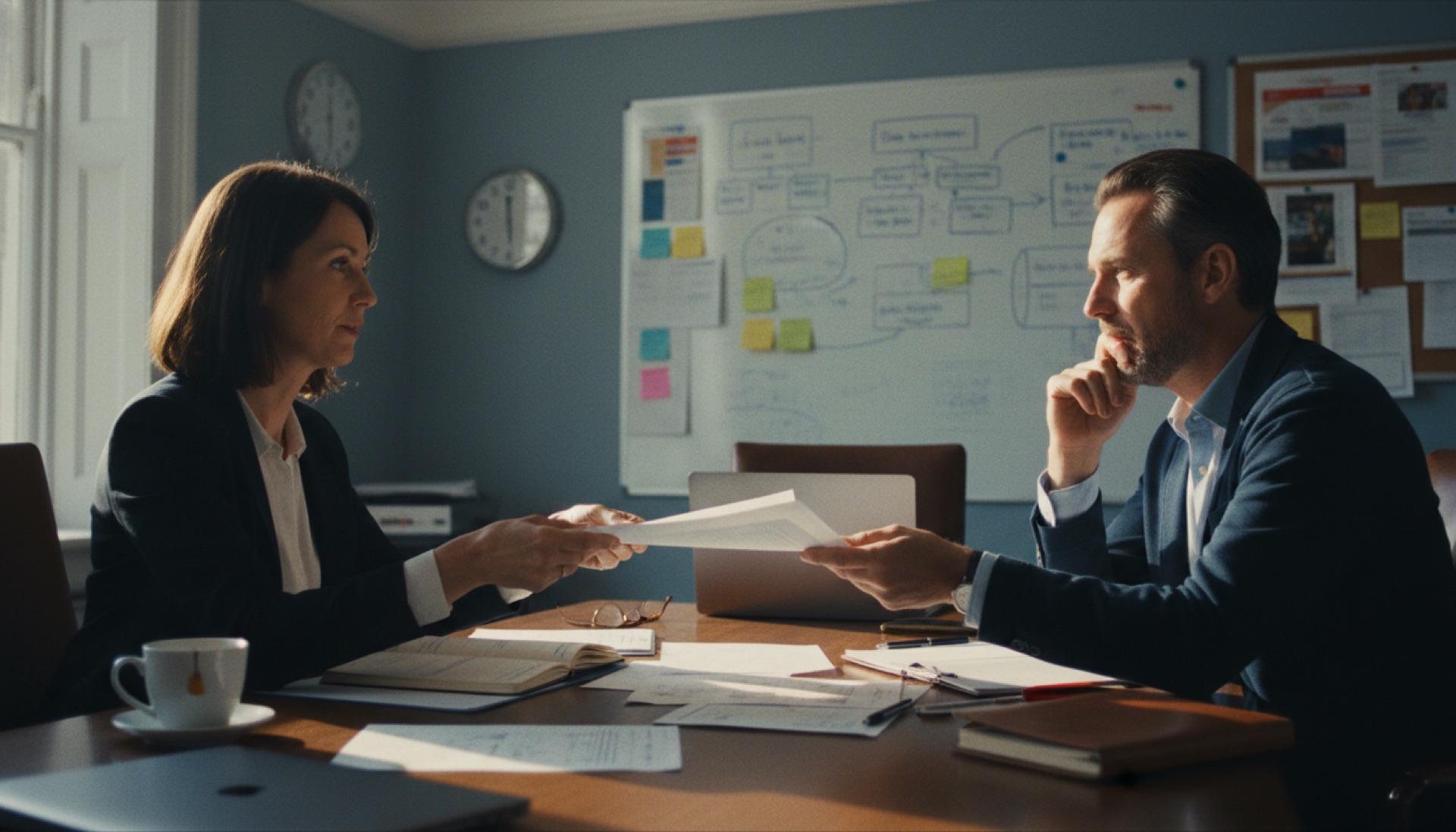
The call is in the diary. Thirty minutes, once a month. Halfway through, both people in the room know what is happening. The delegate is working through a list of things the team tried, what landed, what hit resistance. The founder is nodding, asking the occasional question. Nothing gets decided. The same two or three issues that needed an answer last month are still in the queue, nudged to next time.
That catch-up does not protect the AI programme. It narrates it.
What does a useful founder-delegate AI review actually look like?
A useful review is one where something gets decided. At the end of fifteen minutes, both people should leave knowing what the decision-rights map looks like today, what the numbers actually say, and which calls that were sitting in the joint column are now settled. If those three things happened, the meeting earned its place. If not, it was a status report with better attendance.
The distinction matters because the reason AI programmes stall is rarely the technology. MIT NANDA’s 2025 research found that around 95% of generative AI pilots fail to reach meaningful revenue impact, with the cause consistently identified as a gap in how the work is embedded in real workflows rather than any problem with the underlying models. The review is one of the few places where that embedding work gets governed. A review that only reports on activity is not doing that work.
Why does the default catch-up fail to decide anything?
The pattern is recognisable. The delegate comes in with a list of what happened. The founder asks questions, answers arrive, and at the end of thirty minutes the only decision taken is to keep going. BCG’s 2025 research found roughly half of companies stuck in stagnating or emerging adoption stages, unable to scale past proof-of-concept. The review is where that stall gets narrated, not fixed.
There are three reasons the default review fails. First, it is built around activity rather than decisions. The review covers what the team tried, what got used, what stalled, but none of that tells either person whether the programme is heading in the right direction. Second, decisions that need both parties get deferred because the agenda has no structure for settling them. Third, the decision-rights map drifts. When it is never checked, both people gradually develop a different picture of who is responsible for what, and that gap turns into interference, with the founder pulling decisions back without naming it as a pattern and the delegate second-guessing calls that should be theirs.
Change-management research is consistent on this: technology programmes fail on the people and leadership side far more often than on the technical side. The fix is a different agenda, not a longer meeting.
What are the three things every review needs to cover?
The structure is a three-part check, done in order, every time. First, are the decision rights still mapped accurately? Second, what does the shared scorecard say about progress? Third, which calls that were sitting in the joint column do we settle today? Each part is a different conversation, and conflating them is one reason the default review never decides anything.
The rights check is the one most easily dropped. When things are running smoothly, checking whether the mandate is still accurate can feel like admin. The brief the delegate received at the start of the programme was set at a moment in time. Since then, the founder’s priorities may have shifted, board pressure may have changed, and new risks may have emerged. Checking the map at each review keeps the delegate’s mandate current, rather than allowing it to drift until it surfaces as a conflict.
The scorecard should show the two or three things both sides agreed actually indicate whether the programme is working, not simply log what the team tried. Dual-ROI thinking helps here. Commercial outcomes and the founder’s own capacity to step back from operational decisions are both valid metrics, and treating both as live measures gives the review something concrete to examine rather than something to narrate.
The joint column is the list of calls that genuinely require both parties. Keeping it short, and settling it in the review, is what creates the space for the delegate to operate with real authority between sessions.
What does each side bring to the room?
The review only works if both people prepare the right thing. The delegate comes with the calls that genuinely need the founder, not a summary of everything the team did. The founder comes with the changes in motive or board pressure that have shifted the brief since last month. Two-sided preparation, kept short, is what makes the fifteen-minute frame possible.
For the delegate, the preparation question is direct. What decisions am I holding back because I am not confident they are mine to make? If the answer is a long list, the rights map needs recalibrating, not a longer meeting. Spencer Stuart’s research on CEO engagement in AI programmes flags the risk of verbal delegation without follow-through. When the founder keeps pulling decisions back, the organisation learns that AI is the founder’s call after all, and the delegate’s authority dissolves. Reverse delegation, as the leadership literature describes it, accumulates across many individually reasonable interventions until the delegate’s autonomy has been hollowed out. Bringing the right calls to the review, and having them settled, is the mechanism that prevents that pattern.
For the founder, the preparation is about context. Have priorities shifted in the past month in a way that changes what the delegate was asked to deliver? Has the board raised something that moves the goalposts? Has the exit timeline changed? These are things the delegate cannot know unless the founder names them, and they directly affect whether the brief the delegate is working to is still the right one. When the AI programme runs through the founder rather than being genuinely delegated, it reinforces founder dependency rather than reducing it, and that has a direct bearing on exit value.
How do you keep it to fifteen minutes and stop it drifting?
Fifteen minutes is a discipline, not a time slot. The meeting drifts when the agenda has no shape, when the delegate has not been clear about which decisions actually need the founder, or when the founder treats the review as an opportunity to go deeper into the work. A regular rhythm also helps. The less time between reviews, the shorter the backlog each one needs to clear.
BrainStorm’s research on executive sponsorship in technology programmes found that organisations reaching high adoption consistently showed sustained leadership communication rather than a single kick-off. The cadence is the sponsorship signal. A founder who appears on a predictable rhythm, engages briefly, and then genuinely steps back sends a clearer message to the organisation than one who dips in irregularly and at length.
Kyndryl’s 2024 data found that only 14% of organisations have successfully aligned their workforce, technology, and business goals. The gap between declaring an AI programme and genuinely embedding one is, in large part, a leadership continuity problem. The standing review is one of the tools that closes it, but only if it is protected from becoming the interference it was designed to prevent.
If a question arises in the review that would take more than a few minutes to resolve, it gets noted and a separate slot booked. The review settles the joint column and checks the map. Everything else has its own conversation. If both people leave knowing exactly what changed and what they are each doing next, the review worked. If they leave with the same questions they arrived with, the problem is the structure, not the AI programme.