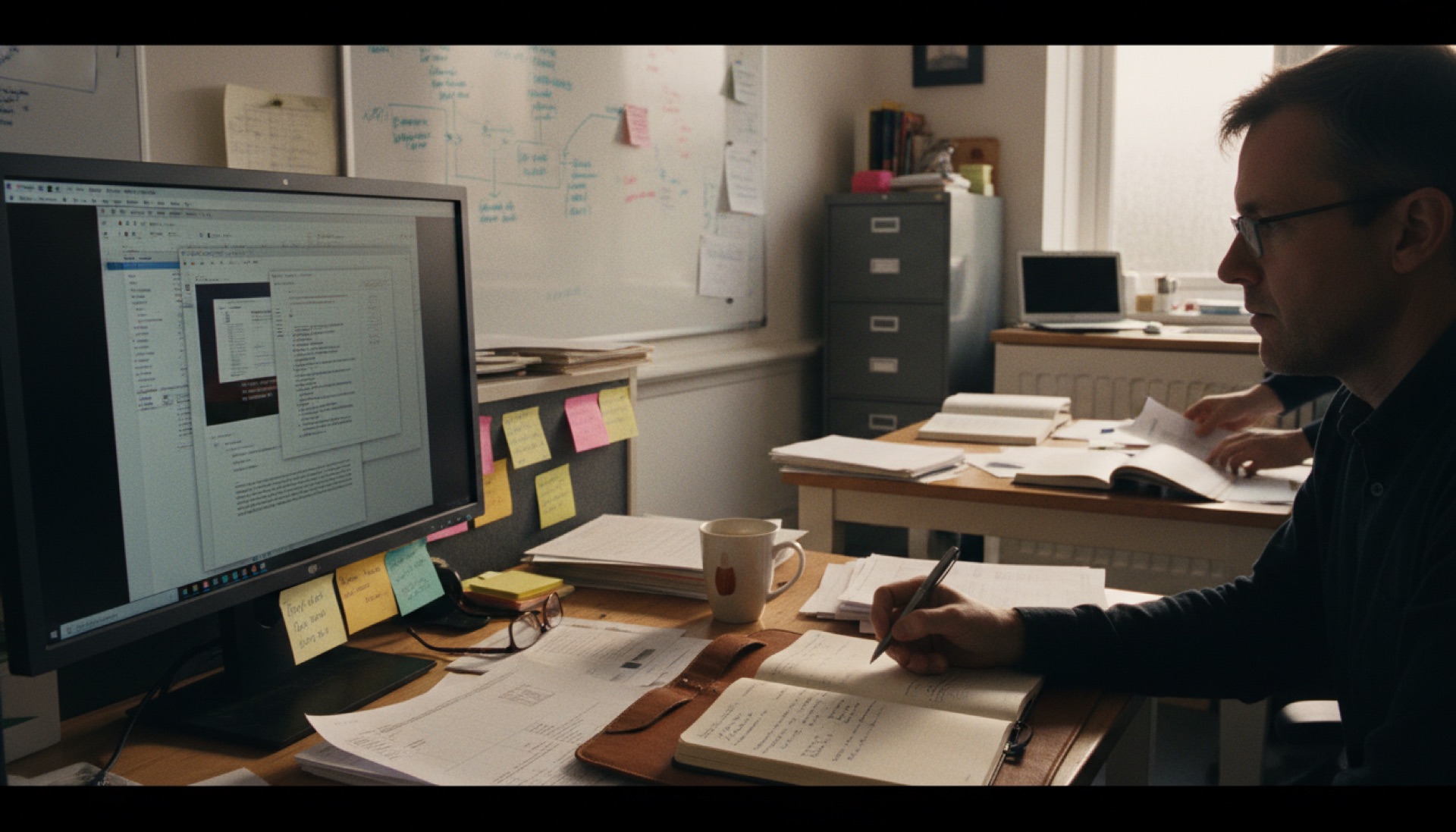
The delegate hands in their notice on a Tuesday. The AI programme is eighteen months old, tools are running, a few workflows have genuinely changed. There is a dashboard. What neither party has checked is how much of what made the programme work exists only in the space between two specific people, and how quickly that disappears when one of them leaves. Many AI programmes discover the answer at the worst possible moment.
What is an AI handover ritual?
The AI handover ritual is the structured process both sides run when the mandate changes hands. Standard offboarding handles tools and data. The ritual handles what offboarding misses. A decision-rights map pins down who can approve new workflows and who escalates. A shared scorecard captures the logic both parties used to judge progress. A founder-motive brief names why the programme exists. Without all three, a successor inherits infrastructure, not context.
A new delegate can find the tools in ten minutes. Reconstructing the logic behind the decisions takes much longer without help. Which problems was the previous delegate told to fix first, and which to park? What did the founder actually mean when they said the programme was going well? Those answers exist somewhere, but not in any file the tools produce.
The ritual runs in both directions. Both sides sit down together before the departure and produce specific outputs. That conversation is where the invisible logic becomes transferable. It also sets the tone for the working relationship between the founder and the incoming delegate, before a single decision has been made.
Why does the second handover break so many AI programmes?
The first handover, when the founder gives the mandate to a delegate, usually gets some attention. The second one, when that delegate leaves, rarely does. By that point the programme looks established. Dashboards run, a few workflows have changed, tools are in use. What is not visible is how much of the programme logic lives in the shared understanding built between two specific people over months of working together.
BCG research published in 2025 found roughly half of companies remain stuck in stagnating or emerging AI stages, unable to scale beyond proof-of-concept. A personnel change at the wrong moment does not cause that stagnation on its own, but it reliably disrupts the momentum carrying a programme past the plateau. Change management research confirms the pattern. Technology rarely fails on technical merits. It fails when the people and leadership work is underestimated.
The delegate who built the programme made dozens of decisions the incoming delegate will have to remake. Every one of those decisions, from which vendors to prioritise to which team requests to push back on, exists as reasoning in the outgoing delegate’s head rather than in any file the tools produce. Without a handover ritual, those calls get remade from scratch.
Where does the programme context actually live?
Programme context lives in three places. Tools and data transfer automatically when a delegate leaves; they sit on servers, not in heads. The decision-rights map transfers only if someone wrote it down, which few delegates ever do because the decisions felt obvious in the moment. The founder’s motive for the programme almost never gets written down at all, and it is the hardest thing for a successor to reconstruct.
The decision-rights map is what causes the most immediate disruption. An incoming delegate who does not know what sits within their authority will either over-ask the founder, recreating the dependency the delegation was meant to reduce, or under-ask and make decisions the founder later reverses. Both patterns teach the organisation that AI decisions are not really delegated. Spencer Stuart’s analysis of CEO power use in AI frames this as the delegation-vs-abdication distinction. Clear decision rights determine whether the founder stays out. Ambiguity pulls them back in, regardless of what the mandate says.
The founder-motive brief is what causes the longest-term damage when it goes missing. A programme built around a motive the successor cannot see will drift. The incoming delegate rationalises their choices against the tools they inherited rather than the outcome the founder was reaching for, and over time the programme bends toward what the tools do easily rather than what the business actually needs.
What goes into the pack, and what does each side owe the other?
The handover pack is built by both sides together, not written alone by the outgoing delegate on their last week. The building process is half the point. It forces the founder to articulate their current motive, which is often different from what it was eighteen months ago, and it forces the outgoing delegate to name decisions they have been making by instinct rather than by any written process.
Four components make a handover pack functional rather than ceremonial. The decision-rights map lists what the delegate can approve alone, what needs the founder’s sign-off, and what sits outside the programme’s scope entirely. The shared scorecard carries the definitions alongside the numbers, not just the targets. The parked-opportunities list names what the programme almost tackled but deferred, with the reasoning behind each deferral. The founder-motive brief is one page, written by the founder, with the outgoing delegate asking the questions that surface what has not yet been said.
The outgoing delegate owes the successor context that no dashboard shows. The founder owes the incoming delegate legitimate standing in the organisation, the kind the previous delegate earned over months, along with a clear signal to the team that this person speaks for the founder on this programme. Without that signal, the organisation reverts to treating AI decisions as the founder’s call, regardless of how the mandate was written.
How does a clean handover connect to exit-readiness?
A delegated AI programme that survives a personnel change shares one quality with an exit-ready business. It is documented, owned, and does not depend on any single person’s continued involvement. M&A advisors consistently identify owner-dependency as one of the largest discounts to an exit multiple, with buyer reductions of 30 to 40 per cent common when operations and decisions remain tied to the founder rather than systematised.
Exit-readiness frameworks now score leadership dependency and process maturity as core pillars alongside financial performance. A programme that resets every time a key person leaves is evidence of the kind of owner-dependency that buyer due diligence specifically looks for. A programme that survives a handover because both sides ran a ritual and produced transferable documents is evidence of the opposite.
For a founder considering stepping back from operations rather than replacing a departing delegate, the logic holds equally. The step-back scenario changes the source of the mandate itself, not just the executor. Running the ritual before stepping back is how the founder exits the active AI programme without the programme exiting alongside them. The board and any future acquirer can see the difference between a programme that ran well because of one person and a programme built to run without any single person in the room.