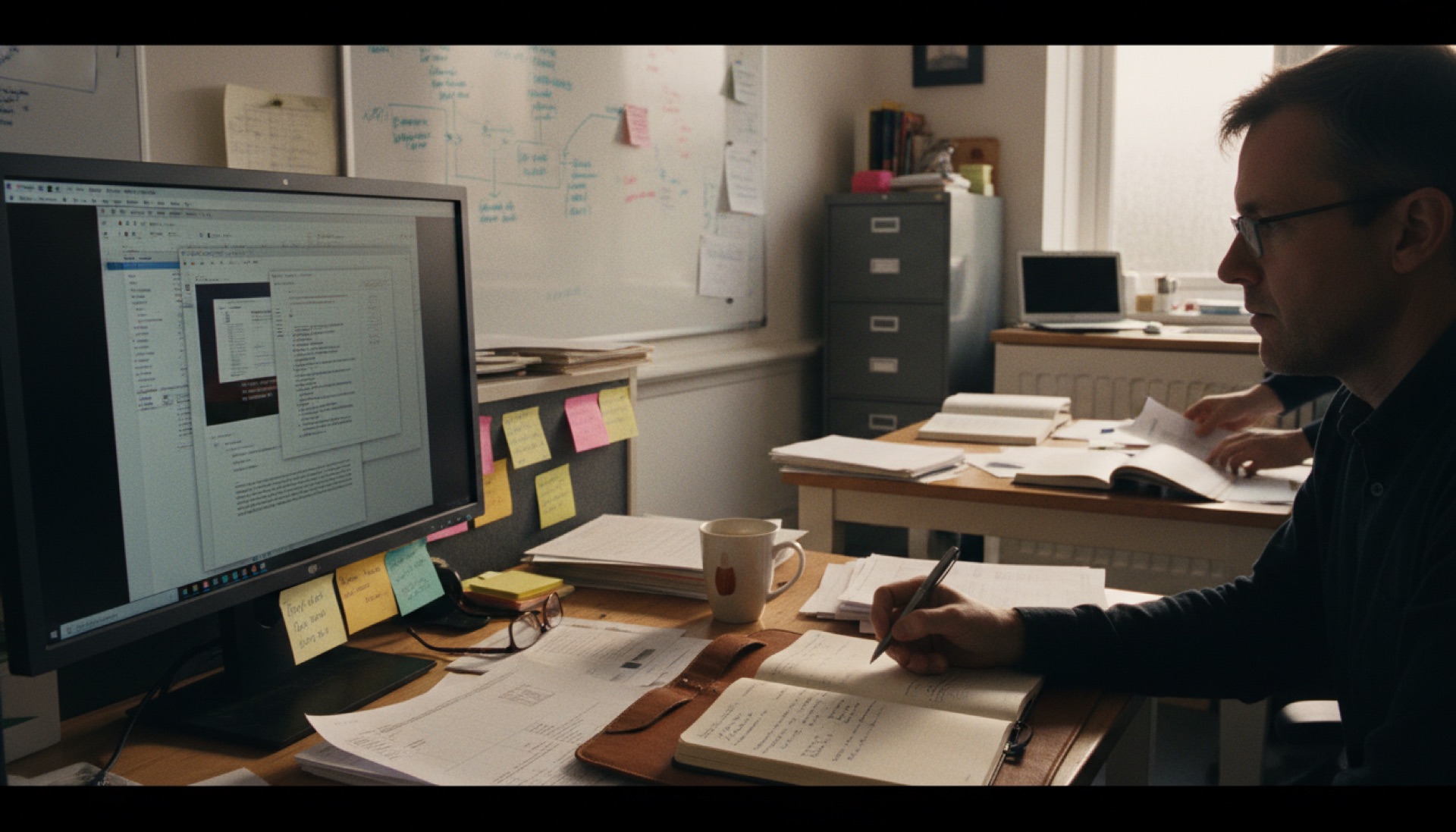
A pattern runs through almost every AI pilot that stalls. The tool worked well in testing, the business case was clear, and the demo convinced the room. Then week three arrived. The inbox was full, the deadline had moved, and using the AI tool meant stepping outside the team’s normal routine. So they skipped it. By week six, the tool was effectively unused. The tool had been added beside the process rather than inside it, and that positioning determined the outcome.
What does it mean to build AI into an SOP?
Building AI into a standard operating procedure means the tool is the procedure, not an addition to it. When your team follows the SOP, they use the AI because the workflow routes through it. The contrast with bolt-on is practical. Bolt-on places the tool beside the existing steps as an optional shortcut someone might occasionally reach for. SOP-embedded makes the tool the default path.
Consider a standard process for handling new client enquiries. The pre-AI version is a familiar sequence. Someone receives the email, reads it, logs the contact in the CRM, drafts a reply, sends it, and files a note. The bolt-on version adds a note at the foot of the checklist suggesting the AI tool for drafting the initial reply. The SOP-embedded version specifies that the email is pasted into the AI tool at step two, the draft reply is reviewed and sent at step three, and the CRM log is updated from the tool’s summary. Every team member follows the same steps. Nobody has to choose.
The distinction sounds minor until you watch a team under deadline pressure. The bolt-on note disappears first.
Why does bolt-on AI get abandoned?
Bolt-on AI adds a step. Any workflow that runs under time pressure favours the path of least resistance, and the established procedure holds that advantage by default. Adding an AI tool as an optional layer asks every team member to make a conscious choice each time, between following the established procedure and diverting into the tool. Under pressure, they follow the procedure. The tool withers.
BCG’s analysis of enterprise AI adoption found a consistent pattern. Usage metrics often rise in the early months, but the operational impact does not follow. Teams use the tool for easy, low-stakes tasks where it requires no behaviour change, and avoid it on precisely the tasks where the gain would be real. The finding is that returns stay low when AI sits outside the operational flow rather than inside it.
The pilot-to-scale evidence from TechClass points to the same conclusion. Workflow integration and domain specificity are the two features that distinguish pilots that hold from those that stall. An AI tool applied to a vague general task in an optional capacity underperforms. One built into a specific step in a specific procedure delivers.
Korn Ferry’s analysis of AI leadership readiness adds another layer. Organisations that approach AI as a matter of efficiency without redesigning the underlying process see lower adoption than those that redesign the process first. The tool needs to be the procedure before teams will use it like one.
Where in your operation does SOP-embedded AI stick?
Back-office workflows have the strongest track record for SOP-embedded AI. Document processing, reporting, client-intake, and first-draft reviews are procedural enough to identify the exact step where AI replaces or augments human action, and the gain is measurable without waiting months for P&L movement. The finding that consistently surprises delegates is that sales and marketing pilots return far less than back-office work, despite receiving more investment.
The reason for the gap is that back-office tasks have cleaner inputs and defined outputs. You can specify what success looks like, which means you can write it into the SOP. Sales interactions involve context, relationships, and judgment calls that are harder to proceduralize. AI performs reliably when the task description is precise enough to become a step in a procedure.
One way to assess a candidate process is to ask whether you can write down exactly what the AI produces, who reviews it, and what acceptable output looks like. If you can, the process is likely suitable for SOP-embedded AI. If the description still contains phrases like “assess the situation” or “use judgment as appropriate”, that signals more human judgment is required than the current generation of tools handles reliably. Start with the tasks where the specification can be made exact, and expand from there.
When should you rewrite the SOP, and when should you wait?
Rewrite the SOP when the AI tool is demonstrably faster or more accurate than the current step, and when you have defined exactly where the human checks the output. Wait when the underlying data is messy, when the team hasn’t yet calibrated where the tool misjudges, or when the process itself is still being designed. Embedding AI into a broken process just automates the problem.
Human review also needs to be written into the SOP, not left to individual habit. The practical standard is confidence-based oversight. The procedure specifies which outputs move straight to the next step and which get a human review before proceeding. A first-draft email below a defined quality threshold gets reviewed before sending. A contract analysis flagged as low-confidence goes to a qualified reviewer before filing. The threshold is defined in the SOP, not carried in someone’s head.
MIT Sloan’s research on technical debt in AI systems makes a relevant point. AI requires ongoing management as a production capability, not a one-off deployment. Writing the human review step into the SOP from day one is part of that ongoing management. The SOP becomes the governance mechanism, not a separate document filed and forgotten.
What does this mean for exit-readiness?
Every SOP you rebuild around a proven AI tool is also a documented process. Acquirers and investors discount businesses where the method lives in the founder’s or operator’s head. Rebuilding your SOPs to embed AI forces the documentation the business needs anyway, at the same time as it raises output quality and reduces key-person dependency. These two outcomes are the same piece of work.
Owner-managed businesses that have been through due diligence will recognise the pattern. An acquirer wants to see processes that run without depending on the people who originally designed them. They want evidence that the output is consistent and that the method does not rely on tacit knowledge held by one or two people. A business where teams follow AI-embedded SOPs produces both the output and an auditable record of how it is produced.
The delegate who rebuilds a client-intake SOP, a reporting cycle, or a document review process around a working AI tool is doing two things simultaneously. They are building adoption that holds, and they are producing the process documentation the business would eventually have needed regardless. The exit dividend is a by-product of doing the integration work properly, not an additional project sitting alongside it.
A practical starting point is a process the team runs at least weekly, where the current method is documented and the output quality can be assessed. Rewrite the SOP around the tool. Measure whether the gain holds at eight weeks. If you’d like to work through the prioritisation for your operation, Book a conversation.