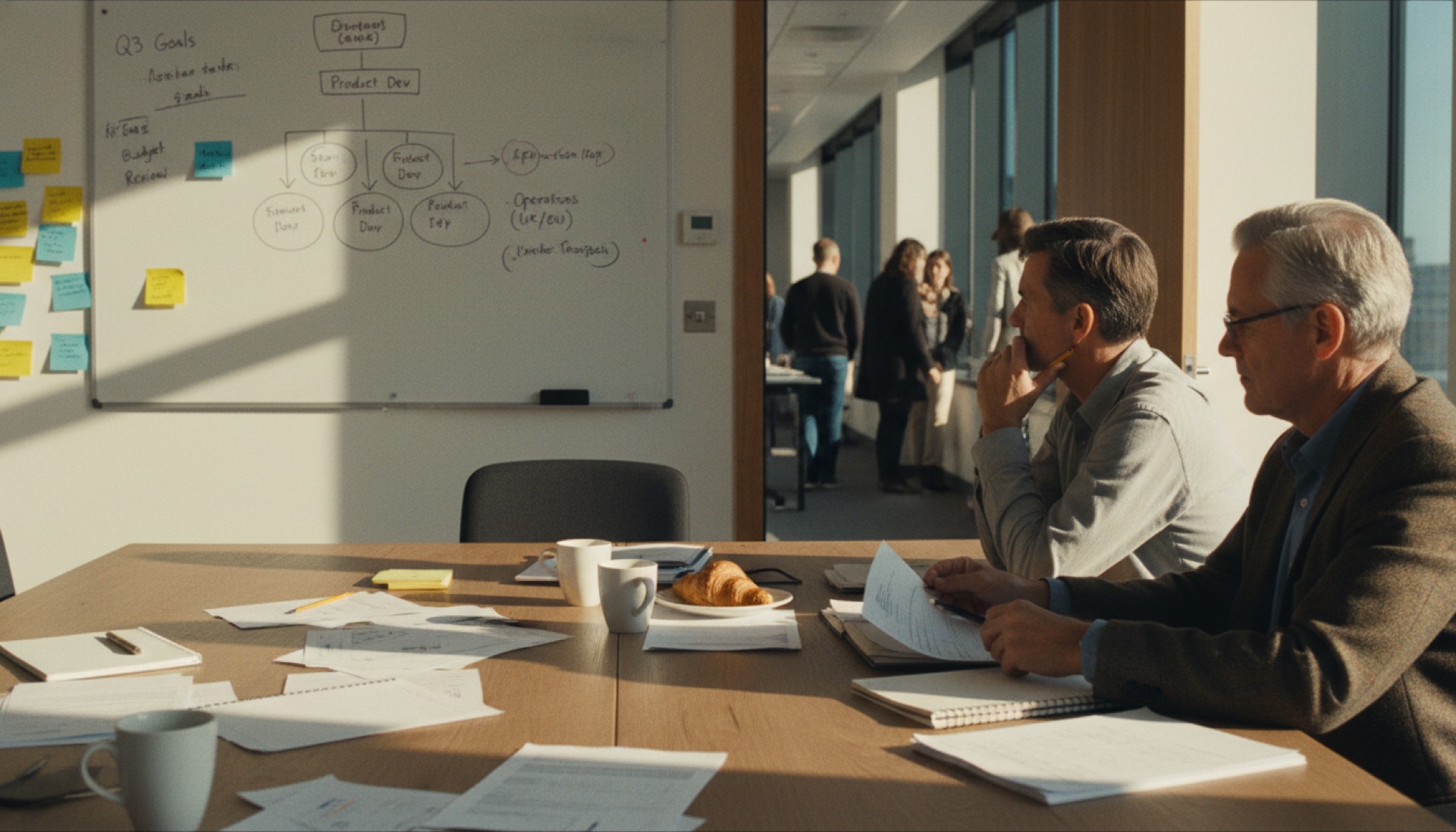
You’re drawing the org chart. The AI owner role is new, the hire is almost confirmed, and you need to assign a reporting line. The most natural slot is under your head of IT or CTO, where the tech budget sits, where the data team reports, where anything with a software licence tends to land.
That instinct is worth examining before you act on it.
What does the IT reporting line actually signal?
Filing the AI owner under IT sends a clear message to every department head before the role has even started. AI is a technical matter, handled by specialists, peripheral to strategy. Research is consistent that treating AI like software, as something procedural for those who know about tech, is a category error. It requires a leadership and operating shift, not an installation.
The error is understandable. Non-technical founders often file AI under IT or digital because that is where technology has always lived. The CTO or head of digital feels like the right authority. Boards frequently mirror the same assumption, expecting the CIO or CTO to own execution even while agreeing that AI belongs at the executive table.
The consequence is an AI owner who spends their days in a technical reporting chain with no mandate over commercial or operational decisions. When the head of sales pushes back on a new workflow, or HR asks why they weren’t consulted, the AI owner has nowhere to stand. They escalate to IT. IT escalates upward. The programme stalls.
BCG’s 2025 research finds roughly half of companies stuck in stagnating or emerging AI stages, unable to move past proof of concept. The obstacle is rarely the technology. It is that AI never got close enough to the operating core to matter.
Why does the reporting line shape whether AI sticks?
Adoption research has been consistent on one finding. The strongest predictor of whether AI beds into daily operations is visible, sustained sponsorship from someone with operating authority, not just technical authority. An AI owner who reports into a commercial or operations function arrives at every cross-departmental conversation with the implicit backing of the business, not just the tech team.
MIT’s 2025 research into generative AI pilots found that roughly 95% stall or show no measurable impact on the P&L. The cause is a learning gap in how AI gets woven into actual workflows, and that weaving happens at operations level, not IT level. Governance guidance from the National Association of Corporate Directors now recommends that AI accountability sits with the operating executive rather than the technical function, precisely because the adoption challenge is a people and process problem.
Change-management research is clear that technology rarely fails on technical merits. It fails when the leadership and people work is underestimated. An AI owner sitting in IT is set up to address configuration questions while the adoption challenge, which lives in operations, gets nobody’s sustained attention.
When AI reports to IT, every operational conversation gets filtered through a function that speaks the language of systems and security rather than revenue and margin. Teams comply with minimum effort. The programme reports activity. The actual business impact stays thin.
Where should your AI owner actually sit?
The AI owner’s reporting line should run to the COO or directly to you as the founder. That is where operating decisions get made and where cross-functional authority is real rather than nominal. Reporting to the COO gives the AI owner proximity to how work actually flows, who controls the teams, and where the friction points are that AI can address.
For a founder-led business with a working COO, the COO reporting line is usually the right anchor. The AI owner operates inside the commercial world, not the technical one, and the COO has the authority to draw cooperation from finance, commercial, and people functions without having to escalate.
If there is no COO and you hold the operating reins yourself, the reporting line runs to you. That is workable in the short term, with one important caveat. It only holds if you create genuine space for the role, with clear decision rights and a regular review cadence, rather than keeping the AI owner in a waiting room pending your review of every recommendation.
The cross-functional mandate matters as much as the reporting line itself. The AI owner needs the ability to convene people from across the business, observe workflows, and run changes at team level without having to seek permission from every function head along the way.
What decisions belong to your AI owner, and which stay with you?
Decision boundaries set upfront prevent a common failure pattern in AI programmes, where a founder hands off ownership verbally but keeps stepping back in on key calls, teaching the organisation that the AI owner has no real authority. A short scope document, agreed in the first week, defines which decisions the AI owner makes independently and which require your sign-off.
The AI owner decides alone on tool selection below a cost threshold, workflow redesigns within a specific team, onboarding new use cases within agreed scope, and day-to-day prioritisation across their work plan. You retain sign-off on vendor contracts above a threshold, any change that affects customer-facing processes, decisions that touch personal data, and scope changes to the programme overall.
That split keeps you informed without pulling you back into the weeds. It also gives the AI owner enough runway to build momentum before the first review point.
Where the scope of independent action is explicit rather than assumed, delegation tends to produce better outcomes than open-ended handoffs. When the boundaries are clear from the outset, both sides know where the handoff lives and the organisation stops looking to you every time the AI owner makes a call.
What else shapes whether the reporting line works?
The reporting line sets the tone, but it doesn’t do the whole job on its own. How other departments read the AI owner’s authority is shaped by what they see happen when that authority is tested. If the head of operations defers to the AI owner on a workflow change, every other department takes note. If they push back and you side with operations, the lesson travels fast.
Two other factors tend to determine whether the reporting line converts into real reach.
The first is your visible endorsement in the first few weeks. Attending the AI owner’s first cross-departmental session, or making a single direct statement to the leadership team about the mandate and where it sits, costs you thirty minutes and is worth several months of effort by the AI owner working alone.
The second is the exit-readiness framing. If your medium-term objective is to reduce the business’s dependence on you, the AI owner’s work has to be set up to codify process rather than replicate your personal instincts. An AI owner who reports to the COO is better placed to build systems that run independently of the founder than one who reports directly to you and ends up doing everything through your lens.
Set the line right once and the rest of the work becomes considerably easier.