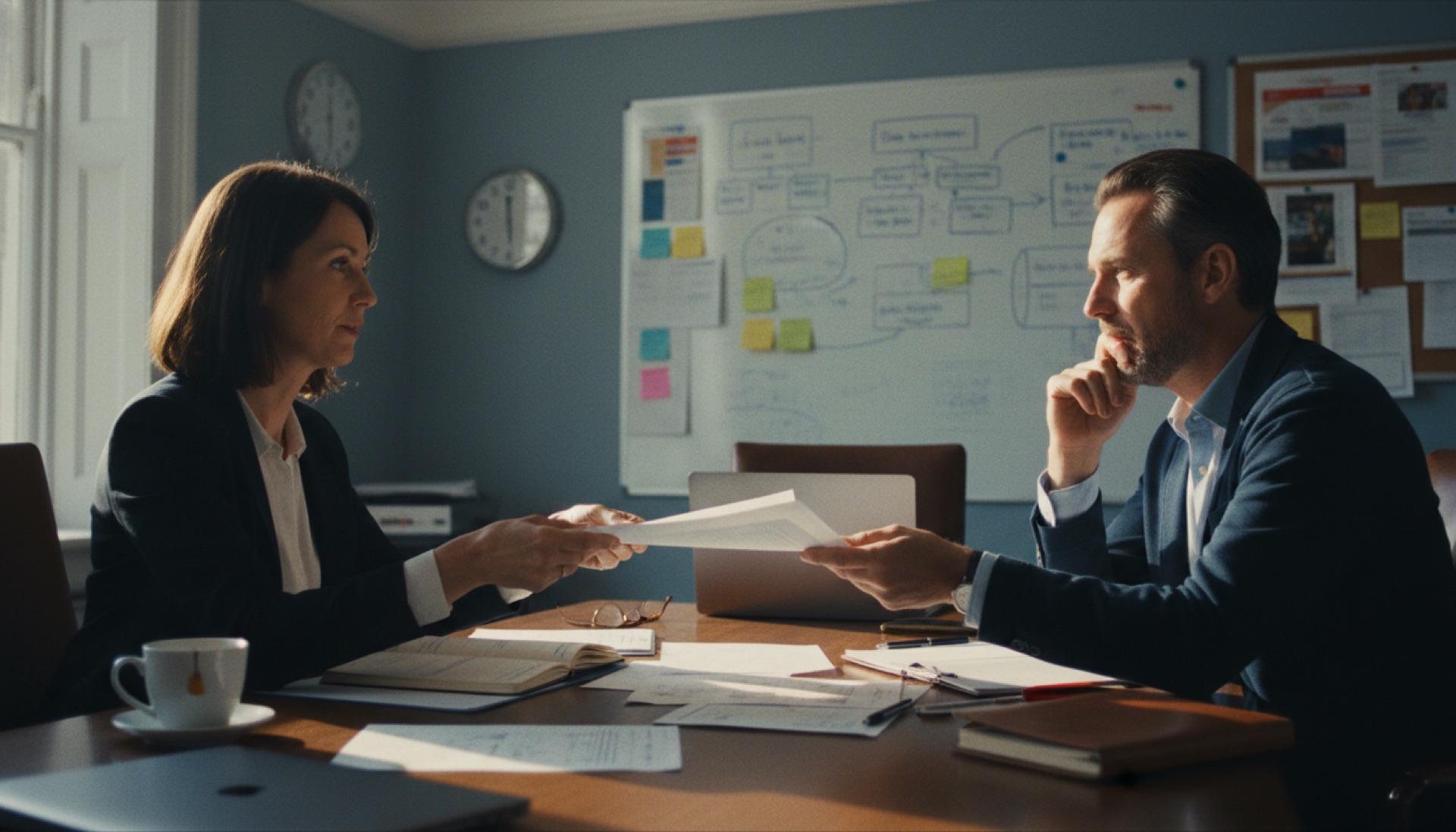
A founder of a 24-person professional services firm sitting through his Tuesday leadership meeting at 10:45 am. It started at 9. It was scheduled for an hour. It has now overrun by 45 minutes. They have spent 35 minutes on context for a customer escalation, 20 minutes on whether to extend a vendor contract, and the founder still has to chair the next meeting at 11. There were no decisions captured, three to-dos vaguely allocated, no clear actions for the week.
He has run the meeting like this for four years. The team comes in expecting it. He thinks the meeting is the problem. The meeting structure is the problem.
Why do leadership meetings fail?
Leadership meetings commonly collapse status reporting and problem-solving into one amorphous discussion, and then spend the bulk of the meeting on context-setting and explanation, with almost no time on actually solving the problem. Information sharing crowds out decision making. Issues get partially aired and partially resolved. To-dos are vaguely allocated and rarely tracked. The meeting reaches its scheduled end without producing the outputs leadership meetings exist to produce.
The fix is structural, not motivational. Reporting and problem-solving are different functions. They need different time boxes, different rules, and different participants in different modes. When the two are mixed, the louder of the two (usually reporting) consumes the meeting and the quieter (problem-solving) gets squeezed out.
The L10 structure, segment by segment
Five-minute segue (opening, personal notes, personal metrics if the firm uses them). Five-minute scorecard review (five to fifteen weekly metrics, rapid on-track or off-track status only, no discussion). Five-minute rock review (three to five quarterly priorities, on-track or off-track status, no discussion). Five-minute headlines (significant events from the week, no detailed discussion). Five-minute to-do review (tracking completion of to-dos from the previous week).
Then sixty minutes of IDS (identify the issues from the scorecard or headlines, prioritise them, discuss root causes, allocate ownership and deadlines). Five minutes to conclude, reviewing all new to-dos, confirming owners and deadlines, clarity check. Ninety minutes total. Never longer. The constraint is the work.
Why the time boxes are non-negotiable
If reporting bleeds into discussion, IDS time disappears and the meeting becomes a status update with no problem-solving capacity. The fixed boxes are the discipline. If a metric is off-track, it goes to the issues list and gets discussed in IDS, not in the scorecard review. The separation between reporting and problem-solving is the meeting’s most important design feature, more important than any individual segment.
In practice this feels obsessive in the first month. The owner of the meeting (typically the operations lead or general manager) holds the time hard. “We are at five minutes, we are moving on. The vendor question goes to IDS.” It feels rude in the early weeks. It is the work. By month three the team uses the structure naturally and the meetings produce more in 90 minutes than the previous 120-minute version produced in three months.
The Rockefeller cadence layers
Daily huddle of 15 minutes, working team plus their direct leader, three segments. What was completed yesterday. What is being worked on today. What is blocking progress. The huddle exists to surface blockers that the weekly meeting will solve, not to solve them in the moment. Weekly L10 of 60 to 90 minutes, leadership team only, the structure described above.
Monthly review of 2 to 3 hours, all-management, trend-checking and course correction across functions. Quarterly off-site of half-day or full-day, strategy and rocks reset for the next 90 days. Each cadence layer has a distinct purpose. The daily surfaces blockers, the weekly solves them, the monthly checks whether the solutions are working, the quarterly re-prioritises based on what has been learned. The system is the four layers together, not any one in isolation.
The cadence calendar as durable artefact
The cadence calendar is a simple document listing every recurring meeting, with day, time, duration, attendees, owner, and agenda. Published in a shared space (Confluence, a shared Doc, the calendar system). Reviewed quarterly to ensure it stays accurate. Once published, the cadence becomes the default. “The leadership meeting is Tuesday at 9 a.m., 90 minutes, these seven people, this agenda, always.”
There are no “let’s move it this week” exceptions. Cancellation is rare and requires explicit founder authorisation. The consistency is the point. The team knows when to show up, what to expect, and what to bring. The cadence calendar is the artefact that makes the rhythm actually stick. Without it, the structure works for two months then drifts back to the unstructured pattern.
Rocks versus OKRs in an SME
Both frameworks share the principle that focus requires limitation. Trying to prioritise everything is equivalent to prioritising nothing. Rocks are simpler. Three to five quarterly priorities, weekly on-track or off-track, owned by a single person or small team. OKRs are more granular, with numerical scoring, partial achievement, and a target success rate of 70 percent. In a 50 to 500-person firm with dedicated data infrastructure, OKRs can add precision worth the overhead.
For an 8 to 50-person firm, rocks are usually sufficient. They create the necessary focus and accountability without the administrative weight of OKR scoring. The wrong choice is to install OKRs because the firm read about Google’s system, then abandon them six months in because nobody had time to score them. Rocks first; OKRs only when the analytical capacity to maintain them properly is in place.
The one-to-one as a separate cadence
The 30-minute one-to-one between the founder and each direct report is its own cadence, separate from the L10. Weekly or fortnightly. The employee sets the agenda. The founder listens more than speaks. The meeting ends with one or two commitments for the coming week. It is not a status check.
The agenda comes from the employee, the founder asks open questions rather than giving advice, and the cadence is consistent enough that the team can rely on it. Research on engagement consistently shows employees who engage in regular structured one-to-ones with their managers are more engaged at work and turnover drops. The one-to-one is the relationship layer underneath the L10’s operational layer. Founders who run the L10 well but skip the one-to-ones find their leadership team is operationally effective and emotionally disengaged. Both layers matter.
What to do this week
Rebuild your next leadership meeting against the L10 structure. Block exactly 90 minutes. Print the segment timing on a single page and put it in front of the meeting owner. Hold the segments hard. The first L10 will feel awkward; expect that. By the third or fourth, the team will start using the structure and the meeting will produce more in 90 minutes than the previous version produced in two hours.
After three weeks, build the cadence calendar. List every recurring meeting in the firm. Review the list at your monthly review. Cancel what does not have a clear purpose, redesign what is loosely structured, hold the L10 as the centrepiece.
If you would like a second pair of eyes on whether the cadence is the bottleneck or the meeting structure is, book a conversation.