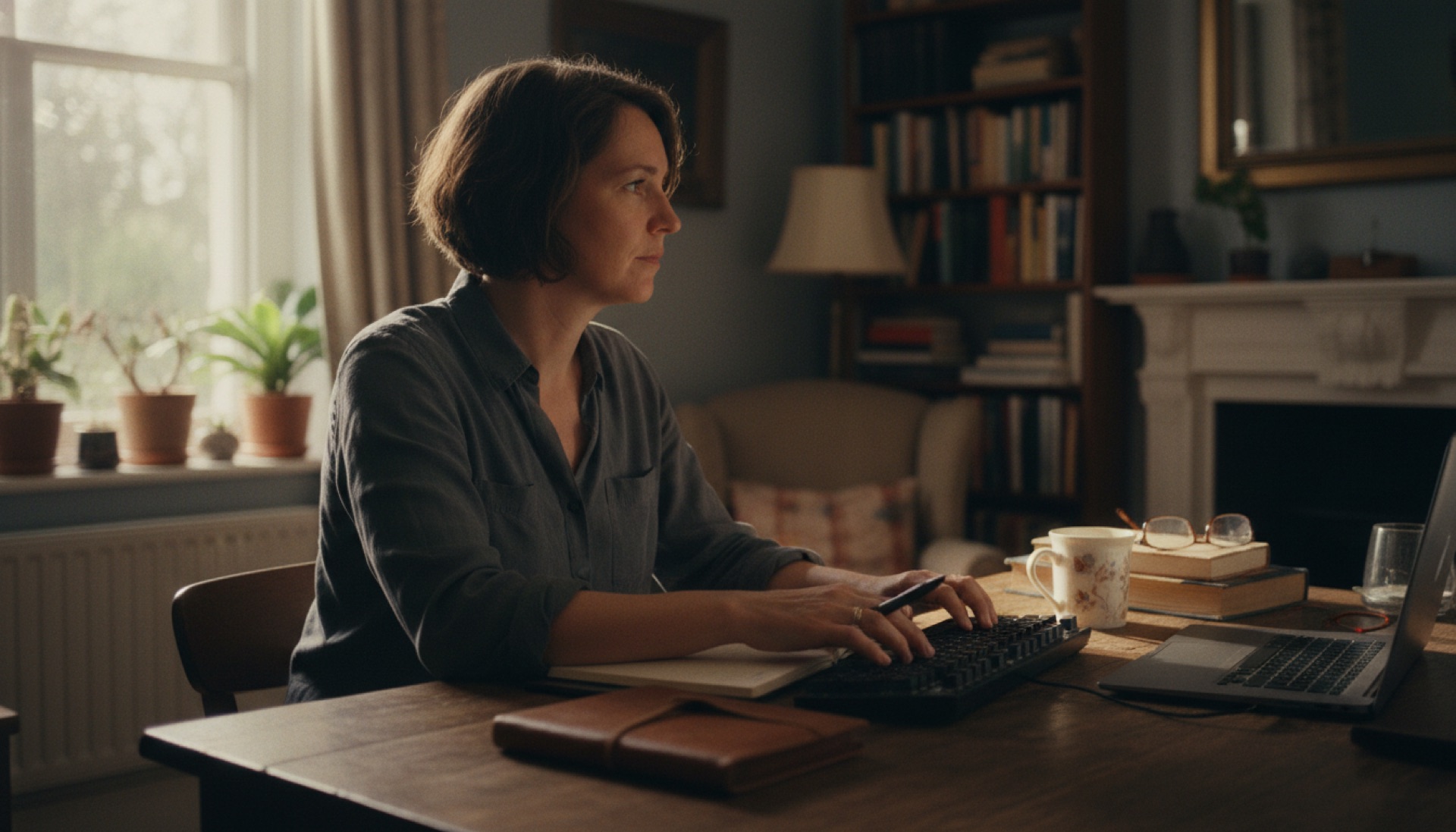
A founder I spoke to last month had heard me say “I use AI for X” three times on different podcasts and never quite seen the wiring underneath. So here it is, opened up. Not the version where I tell you what to buy. The version where I show you the desk I actually work at on a Tuesday morning in May 2026, what each tool replaced, when the prompt library gets called, and the two things I will not let AI touch.
A note before the walk-through. Wade Foster opened his stack on Lenny’s Newsletter, Drew Houston walked his on Latent Space, Aaron Levie did the same, and Tobias Lütke turned the question into an internal mandate at Shopify. The fact that four named operators are publishing this kind of disclosure is the point. Your stack will look different. The shape rhymes.
What is actually in my active rotation in May 2026?
Five tools, costing roughly £142 a month all in. Claude Pro for the long-form writing and reasoning loops, ChatGPT Pro for image work and the moments its retrieval wins, Perplexity Pro for citation-grounded research, Granola for meeting notes, and Cursor for any code I write. Each replaced something specific. A writing partner, a Google habit, and a typed-notes-after-the-call process I never quite kept up with.
The pattern across Foster, Houston, Levie, and Willison is the same. A small rotation of named tools, picked for the work, kept stable for months. None of them list 20 apps. Foster’s disclosed stack is closer to seven. Willison’s curated tools list is opinionated and short. The reverse pattern, where a founder runs every new launch in parallel, is the productivity-paradox trap Cal Newport has been writing about for two years and the NBER survey of 6,000 CEOs picked up in the data, with 67 percent using AI and 90 percent reporting no productivity impact, mostly because tool-fragmentation eats the gains.
Where does the standing prompt library live and how is it called?
The prompt library is a single Notion page, eleven recipes, each with a name, an input shape, and an expected output. It opens with the Monday intake at 9 a.m. and closes with the Friday synthesis at 4 p.m. Recipes include “weekly inbox triage”, “draft client follow-up after first call”, and “synthesise the week’s decisions into a log entry”. The names matter more than the prompts.
Wade Foster describes the equivalent on Lenny’s, a personal recipe collection rather than one heroic chat. Drew Houston talks about the same pattern on Latent Space. The reason is mechanical. A named recipe means you call it without thinking, and you maintain it when it drifts. A free-form chat means you re-explain context every time and the quality degrades by Wednesday. Recipes also surface the work that should not be in AI at all, because when you go to write the recipe and cannot, that is information.
What do the Monday and Friday rhythms look like end to end?
Monday is intake and triage, roughly 75 minutes. Inbox triage in Claude with a fixed prompt that classifies into respond-now, respond-this-week, file, or delete. A Perplexity sweep on the three live client questions where the world might have moved over the weekend. A Notion recipe drafts a one-line agenda for each meeting. The output is a paper sheet of priorities and three pre-drafted replies.
Friday is synthesis and the decisions log, roughly 60 minutes. Granola transcripts from the week feed a recipe that pulls out commitments I made, pricing positions I held, and any moment a client asked something I did not know cold. That feeds the decisions log, a single Notion page I have kept since 2024 and which is now the most useful single document in my business. Drew Houston describes a similar weekly synthesis on Latent Space, and Aaron Levie talks about Box’s internal agents doing the same job at company scale. Tuesday to Thursday are mostly tool-free deep work with AI on tap rather than always on, which is the opposite of the always-on default the tooling vendors push.
What are the two things AI does not touch in my week?
Two boundaries, both deliberate. First, sensitive client conversations. Anything emotionally weighted, any moment a founder is telling me something they have not told their co-founder, any first call about leaving a business. No transcript, no AI-assisted prep, no synthesis afterwards. The work is relational. AI does not improve it and a record of it is a liability. Granola gets switched off and I take notes by hand or not at all.
Second, the four daily deep-work hours. Laptop shut, phone face down, AI off the desk. Cal Newport’s argument is the right warning. The founders I see lose ground are the ones who have put AI on every task, who feel busier and less productive, and who have no quiet hours left in the week. Brad Feld writes about this from a different angle in his “AI and life” pieces on his blog and lands in the same place, window-bound use with hard boundaries the tools cannot cross. The discipline is about timing and fit, not volume.
What would I change if I were starting again in 2026?
I would buy Claude Pro first and sit on it for a fortnight before adding anything else. That is the opposite of what stack-disclosure posts often imply. The reason is compounding. A founder who runs three new tools in parallel from day one learns three half-things and writes no prompts worth keeping. Two weeks on a single tool teaches where it fits and what to buy second.
After Claude, I would add Perplexity, then Granola once the meeting load justifies it. Cursor only if you write code. ChatGPT Pro is a year-two purchase. The £142 a month is the destination, not the start. Lenny’s “State of Tech Tools” survey shows operators settling at this kind of stable rotation only after a year or more of tinkering. Treating the tinkering as the cost of arrival is the discipline.
The other thing I would change is the prompt library shape. Mine grew accidentally over eighteen months. If I were starting fresh I would write three named recipes in the first week, use them daily for a fortnight, and only add a fourth when one of those three had earned its keep. The library is a working artefact, not a content collection, and the slow growth is the discipline that keeps it that way. If you would like a second pair of eyes on which tool to buy first and what to take off the desk, book a conversation.