
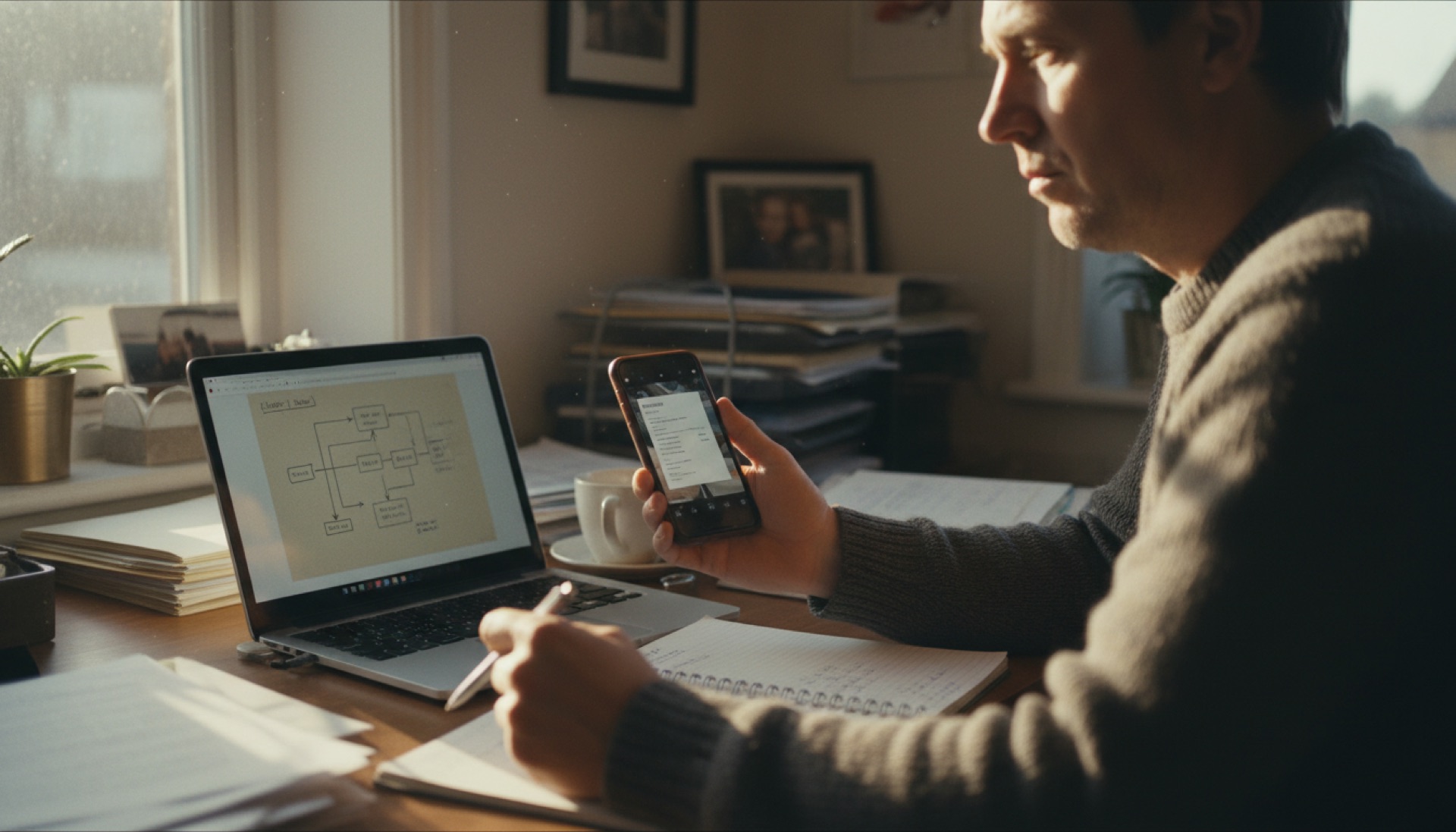
A finance director sent me a phone photo of a supplier invoice, asked his chat tool to read it, extract the numbers and tell him whether they matched the purchase order in another tab. The tool did all three in one pass. He asked, half-impressed and half-suspicious, “Is that what people mean by multimodal?” Yes, that was a clean example.
It is also the kind of example vendor pitches in 2026 want to claim. Multimodal has become the new headline feature, sometimes attached to genuinely integrated systems and sometimes pinned onto a chat panel that handles text and nothing else. The plain-English version tells you which is which.
What is multimodal AI?
Multimodal AI is a single AI model that takes in and produces more than one kind of data, text, images, audio or video, inside the same system. The defining word is “single”. GPT-4o reads a photo and a question about it together. Claude reads a screenshot and a transcript in one pass. Gemini was designed to handle all four data types natively from the start. Llama’s vision variants do the same in open-weight form.
The contrasting shape is multi-system AI. A pipeline that runs an image through an OCR tool, then sends the text to a chatbot, is two systems in sequence. The chatbot never sees the image. It only sees what OCR managed to extract. That is useful for tidy printed documents, but it loses anything OCR could not parse, the layout, the handwritten note in the margin, the signature, the smudged total. A genuinely multimodal model sees the original image and reasons across the visual and textual content together.
Underneath, a multimodal model has separate specialist networks for each data type, an image encoder, an audio encoder, a text encoder, and a fusion layer that combines what each has extracted into one shared representation the model can reason over. You do not need the architecture to use the tool. You do need to know that the per-image and per-second-of-audio costs are higher than text, because that economics shapes when multimodal pays back and when it does not.
Why it matters for your business
The first business case is invoice and document processing. An invoice carries text, structure and visual cues, the layout that tells you which column is the unit price, the occasional handwritten note on a delivery slip. A multimodal model reads the whole composition, extracts structured fields, and flags inconsistencies against the purchase order. For a services firm processing several hundred invoices a month, this displaces hours of manual entry and the late-payment errors that follow from typos.
The second is product cataloguing. Retail and e-commerce teams spend serious time turning a product photo into a listing, the description, the attribute tags, the keywords. A multimodal model can take the photo and draft the listing in one pass. The team’s job becomes review and approval. For a small retailer launching a few hundred SKUs a year, the time saved is meaningful.
The third is video and audio. UK accessibility law requires that audio and video content has captions or transcripts. Manual transcription runs at £1.50 to £3 per audio minute. Multimodal AI generates the transcript, identifies speakers and extracts key concepts for a fraction of that cost. The Government Digital Service has been clear that good transcripts help everyone, not only users with access needs. The compliance case and the usability case line up.
The fourth is customer support routing. A ticket that arrives with a screenshot of the error, a short voice note describing what the user was doing, and a typed sentence about the impact carries three pieces of evidence about one problem. A multimodal system classifies it from all three together, closer to how a support agent reads the ticket, and routes better than text alone.
Where you will meet it
You will meet multimodal claims in pitches for document processing, customer support, retail tooling, training and accessibility. The phrasing varies. “Upload a photo and we extract the data.” “Process screenshots and text together in one ticket.” “Generate transcripts and key concepts from your training videos.” All of these are multimodal framing. Some are backed by genuinely integrated models, some are an OCR or speech-to-text tool wired to a chatbot.
You will also meet it inside tools you already use. ChatGPT, Claude and Gemini all accept images and, in newer versions, audio. Microsoft 365 Copilot reads slides and embedded images. Outlook copilots can summarise the screenshot a customer pasted into an email. The capability is increasingly bundled and the cost shows up in token consumption rather than a separate line on your bill.
The most useful place to meet the term is in a demo on your real data. Send the vendor your messiest inputs, the invoices with annotations, the tickets with screenshots, the training video with three speakers, and ask them to show the system handling them in one pass. Genuine multimodal systems do this. Stitched-together systems lose context at the joins, and you can see it in the answer.
When to ask about it, when to ignore it
Ask hard questions when your workflow naturally carries more than one data type and the cross-modal context matters. Invoice extraction is the canonical example. Customer support with screenshots is another. Video accessibility is another. In all three the question to put to the vendor is “is this one model processing all the inputs, or are you chaining a separate OCR or speech-to-text tool into a chatbot?” The honest answer reveals whether they have solved the harder problem or repackaged the easier one.
Ask about the cost economics when volume is high. A high-resolution image can consume 700 to 1,300 tokens, several times the cost of the same information as a text description. Across a few thousand images a month the bill stops being a rounding error. Get a per-request quote based on your actual image sizes and volumes, not a headline per-image rate.
Ignore the term when your workflow is text only. A team using AI to draft emails, summarise meeting notes or rewrite proposals does not need multimodal. A text-only model is sufficient and roughly 25% cheaper per million input tokens than the multimodal equivalent. The premium pays for capability you will never use.
Ignore it too when the vendor cannot provide UK or EU data residency for image inputs that contain personal data. The ICO position on biometric data is unambiguous: a photograph that contains a recognisable face is personal data, and a system that uses facial features to identify the person triggers special-category obligations. Cloud-only processing of customer photographs without a Data Processing Addendum and without residency control is not a compliance gap you want to discover at audit.
Related concepts
Vision model is the older, narrower category. A vision model handles images and produces text or classifications. A multimodal model is broader, it integrates vision with text and often audio in a single architecture. GPT-4 Vision was a vision model. GPT-4o is a multimodal model.
OCR, optical character recognition, is the older specialist tool for converting images of text into machine-readable text. It is fast and cheap on clean printed documents and brittle on anything else. Multimodal document understanding is gradually displacing it for messy real-world inputs, but OCR is still the right answer for high-volume scanning of clean printed text.
Image generation is a separate capability that often appears in the same products. Generation creates new images from a text prompt; understanding reasons about existing images. Multimodal models often do both, but the business cases are distinct.
Tokens are the unit of consumption. Text, image and audio are all counted in tokens, at different rates. An image typically costs more tokens than a paragraph of text describing the same content. Model your per-volume pricing before committing.
Context window is how much information the model can hold in a single request. Modern multimodal models hold hundreds of thousands of tokens, enough to process several documents and several images together. That matters when your task is comparison rather than single-input analysis.
The honest test of any multimodal claim is the demo on your messiest input. The version worth paying for handles it in one pass and shows where each piece of evidence came from. The version worth ignoring chains an OCR step in the background and pretends it did not.


