Thinking out loud with AI, the dictation-and-respond loop

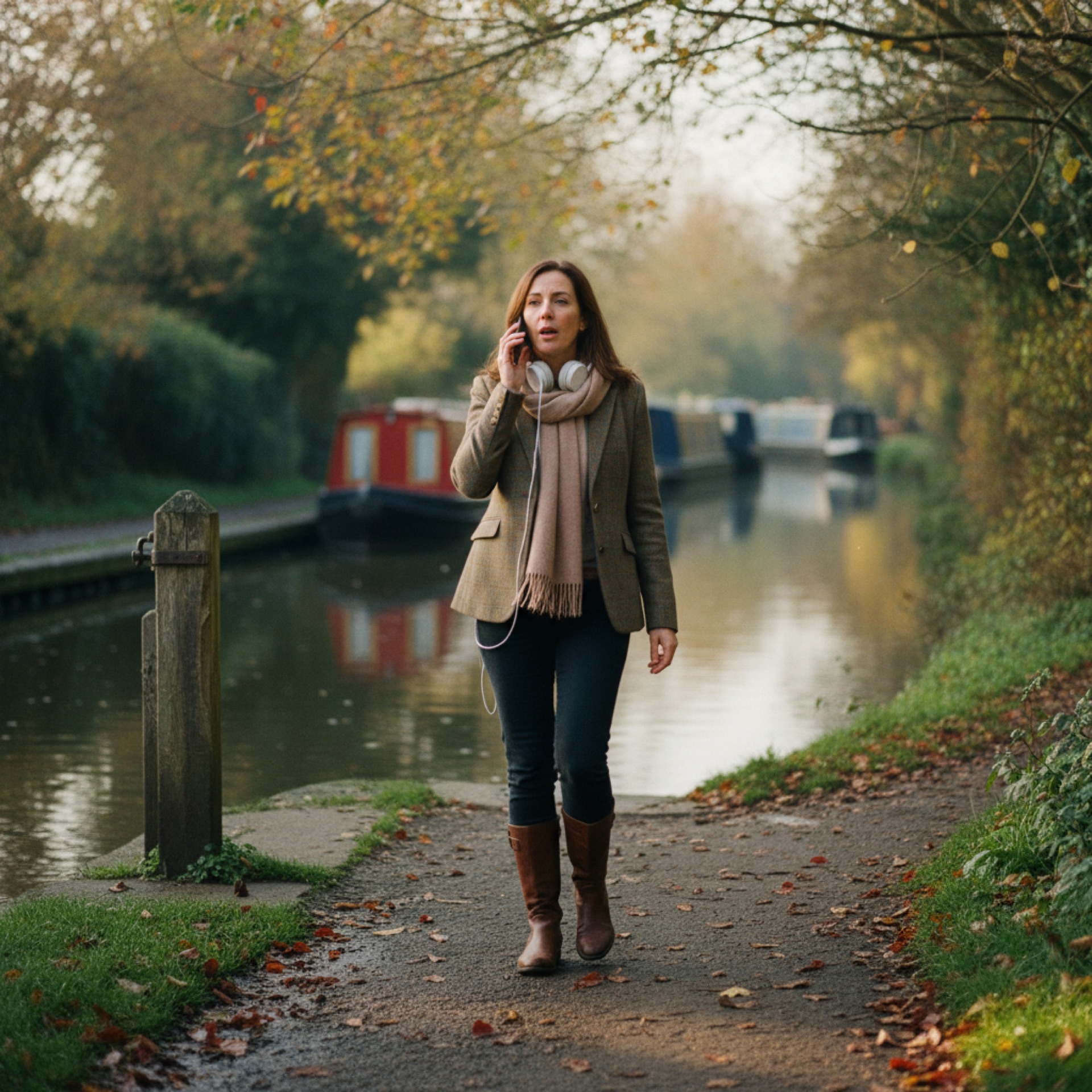
A woman in her late 40s walking along a canal towpath on a crisp morning, holding her phone near her face as she dictates, looking forward rather than down
TL;DR

Thinking out loud with AI means a 30 to 40 minute walk where you dictate your thinking into a voice tool, then ask a model to summarise themes, surface open questions, and flag contradictions. The walk does the cognitive work, the AI captures what would otherwise vanish by the time you are back at your desk. Stanford research found walking lifts divergent thinking output by around 60%. The discipline is acting on one insight per walk.

Key takeaways

- Walking and talking out loud is an old thinking technology. Aristotle's school in Athens was called the Peripatetic school after the walkway its members thought along, and Nietzsche, Kierkegaard and Thoreau all wrote about walking as the place their best thinking happened. - The Stanford research is unusually clean. Oppezzo and Schwartz (2014) ran four experiments and found walking lifted divergent creative output by around 60% on average, with around 81% of participants improving. The effect persisted into the seated work that followed the walk. - The dictation-and-respond loop is three steps: walk for 30 to 40 minutes while talking into a voice tool of your choice, let the tool transcribe, then hand the transcript to a model with a short standing prompt asking for themes, open questions and contradictions. - The standing prompt matters more than the tool. A two-line prompt that asks the model to act as a sceptical listener, summarise the three or four themes, list the questions you left open, and flag the places you contradicted yourself, will make the loop work whether you use AudioPen, Whisper, or a phone voice memo. - The discipline is acting on one insight per walk. Without that, the loop becomes a journaling habit that produces clean transcripts and no behavioural change. One insight, one action, that week.

She does her best thinking on a 40-minute walk along the river before her first call. She comes back with three or four threads in her head that felt sharp at the time. By the time she has made coffee, opened her laptop and answered the first email of the morning, two of them are gone. The third is a fragment she cannot quite reconstitute. The fourth she writes down, badly, and never looks at again.

Many owner-operators have a version of this. The thinking happens. The capture does not.

This post is about a small loop that closes the gap. Walking, talking out loud into a voice tool, and asking AI to listen back. None of the parts are new. The combination, with a model on the receiving end, is finally cheap and simple enough that it is worth treating as a practice rather than a curiosity.

What is the dictation-and-respond loop?

A three-step practice. You walk for 30 to 40 minutes and talk out loud into a voice tool, with no editing. The tool transcribes the audio. You then hand the transcript to an AI model with a short standing prompt asking it to summarise the themes, surface the questions you left open, and flag where you contradicted yourself. The walk does the thinking. The model plays back what you actually said.

The loop sits in the Do quadrant of the EAD-Do framework. AI is not eliminating work, automating it, or taking it from you. You are still the one doing the thinking. The model is a faster, more patient version of the friend who used to walk with you and ask “what did you mean by that?” when you trailed off.

Why does walking and talking actually work?

Because the body and the voice are doing useful cognitive work that desk-and-keyboard work suppresses. Marily Oppezzo and Daniel Schwartz at Stanford ran four experiments in 2014 and found walking lifted divergent creative output by around 60% on average, with around 81% of participants improving. The effect persisted into the seated work that followed the walk. Walking outside scored highest, but indoor treadmill walking against a blank wall still beat sitting.

The historical record points the same way. Aristotle’s school in Athens was named the Peripatetic school after the walkway its members thought along. Nietzsche, Kierkegaard and Thoreau all wrote, separately and without much common ground otherwise, about walking as the place their best thinking happened. None of them were describing exercise. They were describing a specific cognitive state that walking produces and sitting does not.

Talking out loud adds a second layer. Speaking a thought engages language production, motor systems and your own auditory feedback at the same time, which is why explaining a problem to someone often surfaces the answer before they have spoken. The dictation-and-respond loop is letting that happen on a walk, with a model standing in for the listener.

Where do you actually meet this in your week?

Anywhere you have 30 to 40 minutes of moving time and a problem that has gone stuck on the page. The first natural slot is the morning, before the inbox opens. The second is the post-lunch reset, especially on days the morning has been back-to-back calls. The third is the deliberate “I am stuck” walk, taken mid-task when the work is not landing.

The voice tool can be almost anything. A phone voice memo plus a transcription pass works. AudioPen wraps the same idea into a single record button. Whisper sits underneath many of the better-known products. Wispr Flow and Superwhisper are the current options if you want the transcript to land inside the document you are already working in. The choice matters less than the discipline of using the same tool for a month so the friction stops being the topic.

The standing prompt is the part founders commonly skip. A useful version is two lines: “Read this transcript as a sceptical listener. Give me the three or four themes I kept coming back to, the questions I left open, and the places I contradicted myself, in plain English, no preamble.” That prompt, pasted in front of the transcript, gives you a useful response 90% of the time. Tweak it for your own register, then leave it alone.

When should you ask for the loop, and when should you ignore it?

Ask for it when the problem is shaped like thinking, not execution. Strategic calls where the data is in but the decision has not landed. The tone of an awkward Friday conversation. A piece of writing not flowing. A recurring frustration with someone in the team where you cannot tell if the issue is them, you, or the role. In those cases, walking played back through a model beats an hour at the desk.

Ignore it when the work is convergent and answer-shaped. Detailed financial modelling, code debugging, contract review, anything where the cognitive task is narrowing toward a single correct answer rather than opening into possibilities. The Stanford research found walking gave no benefit, and sometimes a small drag, on convergent thinking. Sit, focus, do the work.

Ignore it also when you have not committed to acting on what comes out. The loop without the action turns into a transcripted version of the same thinking that already used to vanish on the walk back. The simplest discipline that fixes this is acting on one insight per walk that week. One insight, one action, before the next walk. Without that, the practice becomes journaling with extra steps.

The closest cousin is using AI as a sparring partner for hard decisions, where the dialogue happens at the desk rather than on a walk and the model pushes back rather than playing the transcript back. The two practices stack, the walk produces the raw thinking, the sparring session pressure-tests the conclusion.

A second neighbour is treating strategy work as a second brain with AI, the same intellectual register applied to a written knowledge base instead of a walking transcript. Founders who run both end up with a private archive of their own thinking that becomes more useful month by month.

The third is the Monday morning what matters this week practice, which is the natural place for the one-insight-per-walk discipline to land. The walk surfaces the thread, Monday morning chooses what to do about it. Read the pillar post for AI on your own desk and the EAD-Do framework explainer for the wider context, the dictation-and-respond loop is one specific Do-quadrant practice inside that frame.

Sources

- Oppezzo, Marily, and Schwartz, Daniel L. (2014). "Give your ideas some legs: the positive effect of walking on creative thinking." Journal of Experimental Psychology: Learning, Memory, and Cognition, 40(4), 1142-1152. The Stanford walking-and-creativity study, four experiments, around 60% average lift in divergent creative output and around 81% of participants improving. Cited as the empirical anchor for walking's effect on the kind of thinking the loop targels. https://aaalab.stanford.edu/assets/papers/2014/Give_your_ideas_some_legs.pdf - Oppezzo, Marily, and Schwartz, Daniel L. (2014). PubMed record for the same study, including the residual-effect finding (creative lift continues into the seated work that follows the walk). Cited as the source for the "do not have to keep walking to keep the gains" point. https://pubmed.ncbi.nlm.nih.gov/24749966/ - National Institutes of Health, PubMed Central (2024). Study on walks in nature and brain activity, finding nature walks produce lower frontal midline theta activity (executive attention) compared to urban walks while preserving creative capacity. Cited as the more recent neuroscience corroboration of the Stanford finding and the mechanism behind why outdoor walking adds a second-order benefit. https://pmc.ncbi.nlm.nih.gov/articles/PMC11549482/ - Mind, the UK mental health charity (2024). The Big Mental Health Report. Policy work documenting the role of physical activity, including walking, in mental health and cognitive function for UK adults. Cited as a UK-named-body anchor for the wellbeing register that sits alongside the cognitive findings. https://www.mind.org.uk/about-us/our-policy-work/the-big-mental-health-report/ - OpenAI (2022 onwards). Whisper automatic speech-recognition system. Trained on around 680,000 hours of multilingual speech, holding up well across accents and noisy conditions. Cited as the foundation model sitting underneath many current AI dictation apps that founders actually use. https://openai.com/index/whisper/ - Mollick, Ethan, Wharton (2025). "Using AI right now: a quick guide" on One Useful Thing. Argues personal experimentation is a prerequisite for sound use of AI, walking through model selection and daily prompting. Cited as the practitioner-academic anchor for the standing-prompt discipline. https://www.oneusefulthing.org/p/using-ai-right-now-a-quick-guide - AudioPen, Pereira, Louis (2024 onwards). Voice-to-clean-text app, single record button, transcribes and restructures spontaneous vocal thought. Cited as the simplest product implementation of the dictation-and-respond pattern. https://www.solveo.co/post/accidentally-created-ai-tool-thats-made-73000 - Perell, David (2024). "Talking can cure writer's block." Note describing the deliberate switch from typing to dictating outlines, then transcribing, then editing. Cited as a named operator's description of the dictation pattern in active use. https://perell.com/note/talking-can-cure-writers-block/ - Mental Health Foundation (2024). Mental Health Awareness Week 2024 report on movement and mental health. UK survey data on the share of adults who acknowledge movement helps mental health and the share who feel they cannot meaningfully act on it. Cited as the UK-context anchor that walking sits at the intersection of cognitive work and wellbeing. https://www.mentalhealth.org.uk/sites/default/files/2024-05/MHF%20-%20MHAW%20Movement%20-%20Report%202024.pdf - Aristotle and the Peripatetic school (335 BC). Reference summary of the school founded at the Lyceum in Athens, named after the walkway (peripatos) along which Aristotle and his followers conducted philosophy. Cited as the historical anchor for walking-as-thinking. https://en.wikipedia.org/wiki/Peripatetic_school

Frequently asked questions

Do I have to walk outside, or does any walking work?

Either works. The Stanford study tested indoor treadmill walking, outdoor walking, and seated controls. Walking on a treadmill facing a blank wall lifted creative output substantially over sitting. Outdoor walking added a further bump on top, with the highest-quality novel ideas in the outdoor condition. The headline finding is that the act of walking does most of the cognitive work; environment is a smaller second-order effect. If a 20-minute lap of a quiet street is what you actually have, take it.

Which voice tool should I use to capture the walk?

It matters less than the standing prompt you put on top. The category options are: a basic phone voice memo plus an AI transcription pass, OpenAI's Whisper running through any of the apps that wrap it, AudioPen for a one-button capture-and-clean, or one of the newer dictation tools like Wispr Flow or Superwhisper if you want the transcript to land directly into a document. Pick one and stay with it for a month, the friction of switching tools eats the gains the loop was meant to deliver.

How long should the walk be?

The working number is 30 to 40 minutes. Short enough to fit before a morning of meetings, long enough that the rhythm of walking has time to do its work. Founders who try the loop usually find the first 10 minutes are throat-clearing, the middle 20 minutes are where the real thinking lands, and the last 5 to 10 minutes are where they start drawing conclusions. Cutting the walk to 15 minutes tends to produce a transcript without any of the middle thinking in it.

This post is general information and education only, not legal, regulatory, financial, or other professional advice. Regulations evolve, fee benchmarks shift, and every situation is different, so please take qualified professional advice before acting on anything you read here. See the Terms of Use for the full position.

Ready to talk it through?

Book a free 30 minute conversation. No pitch, no pressure, just a useful chat about where AI fits in your business.

Book a conversation

Related reading

If any of this sounds familiar, let's talk.

The next step is a conversation. No pitch, no pressure. Just an honest discussion about where you are and whether I can help.

Book a conversation