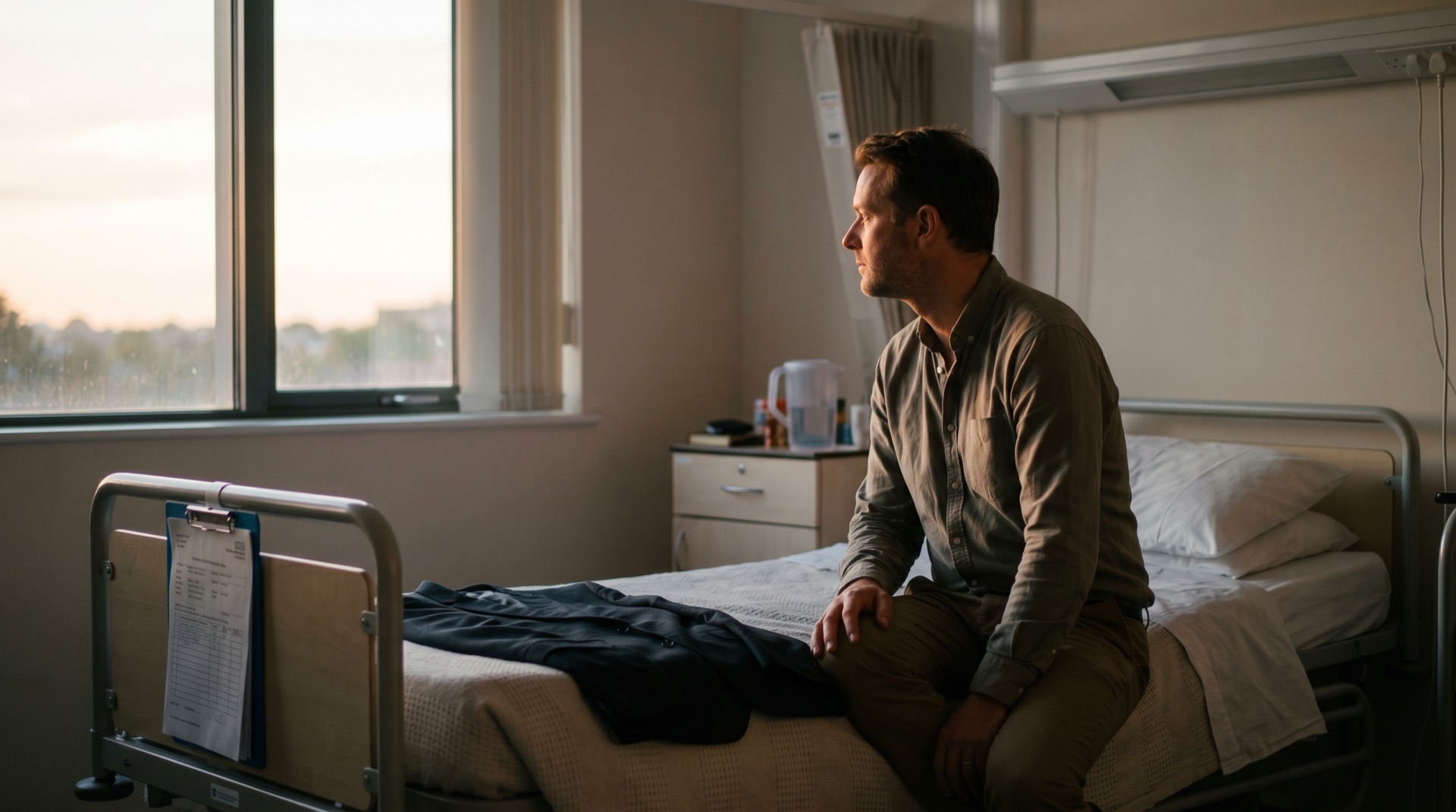
A founder, mid-forties, leads a board meeting on a Wednesday afternoon. Mid-sentence, his vision blurs. There is a pressure behind his sternum he has not felt before. He sits down, dismisses it for a minute, then has to leave the room. By Friday, in a fluorescent cardiology corridor, the consultant asks him one direct question. What is worth your life.
His first answer, the business, the team, the next quarter, sounds absurd in that light. He hears it sound absurd while he is still saying it. That is the moment that does not get unheard, and founders who have been there will tell you it took about thirty seconds.
This piece is for the founder who has had one of these scenes recently and is still inside the window where it might count. The research is consistent on what the window is worth, and equally consistent on how easily it closes.
What does the health scare actually reveal?
The health scare reveals a structural problem, not a wellness problem. There is no person or process that can hold the business through a week of founder absence. That fact has been true for years; the cardiology corridor is the first time the founder cannot dismiss it. The cardiology numbers are the symptom of the structure, and the structure is the cause that the wellness response will leave intact.
Annie Wright, who works clinically with founders on burnout and overfunctioning patterns, describes the cardiac event as a frequent producer of secondary trauma rather than rational planning. The founder’s nervous system has been operating in chronic threat-activation for years. When a health event forces awareness, the response is often panic, dissociation, or aggressive reassertion of control. None of those produce structural change.
The Business Insider account of a UK tech founder’s “widow-maker” heart attack is worth reading. He took six months off and returned to find the company had functioned without him. He described the identity crisis that produced as almost as damaging as the cardiac event itself. His sense of self had been built on being essential, and discovering he was not broke a foundational narrative.
Why does personal resilience not solve this?
Personal resilience does not address a structural problem. The founder who responds with yoga, exercise, better sleep, and stress management is responding accurately to the cardiology numbers and inaccurately to the cause. The business is designed in a way that is incompatible with the founder being unwell for any period longer than a long weekend. No amount of personal optimisation changes that design.
The CIPD’s health and wellbeing data shows high workload as the second most common driver of negative mental and physical health impact for UK workers. For employees, a workload signal eventually reaches a manager and gets escalated. For an owner-manager there is no manager to escalate to. The workload is unmediated, the signal stays inside the founder, and it accumulates in the body until something visible forces a stop.
By end-2025, 2.4 million UK small business owners reported feeling burnt out. The Workplace Journal data sits alongside the PMC NIH self-employed-stress findings. 45 percent of UK self-employed report high stress, 36 percent chronic worry. These are the numbers behind every cardiology-corridor scene. The body has been signalling for a long time, and the structure has been built specifically to override the signal.
What are the four common mistakes founders make?
There are four mistakes founders make in the first weeks after the scare, and many founders make at least three of them. They show up consistently enough to be predictable, and naming them in advance is what gives a founder any chance of avoiding them while the readiness is still alive. None of them feels like a mistake at the time.
The first is treating it as a health problem rather than a structure problem. The founder sees the cardiologist, complies with medication, agrees to walk more, and assumes the work is done. The work is not done; the structure is unchanged, and within six months the same load has rebuilt the same numbers.
The second is sharing the scare too widely too early. The founder tells the team and clients, then has to spend the next month reassuring everyone that they are fine. The reassurance reinforces the founder’s own denial and makes structural change less likely, not more.
The third is bargaining. “I will cut to 45 hours a week” is the most common version. Within two weeks an urgent issue arrives, and the founder is back at sixty. The bargain fails because the structure is still intact; what was cutting the founder back was never their willpower.
The fourth is going back to work without external accountability. The momentum of the scare fades within two to three weeks. Without a coach, an advisor, or a partner who is committed to holding the change, the impulse evaporates. The founder is back at baseline before the cardiology follow-up.
What does the first 30 days actually look like?
An honest first 30 days is sober and specific. It does not look like a wellness retreat. It looks like the founder identifying the two or three operational dependencies that produce the most fragility, picking one, and making one structural move while the readiness is still alive. The window is 14 to 21 days; the move needs to land inside it.
The first move is to write down what would have to be true for the business to function for two weeks without the founder. Not in theory. Not in some future state. In two weeks. Whoever the most capable person below the founder is, whatever the bottleneck decision is, whatever the client relationship is. The list is rarely longer than five items, and the act of writing it surfaces the structural problem more accurately than any cardiology report.
The second move is to delegate the smallest item on the list this week, with real authority, to whoever is closest to it. Real authority, the version where the founder does not get the daily check-in. The founder will feel the urge to take it back; the urge is the structure asserting itself, and noticing the urge is the work.
The third move is to engage external accountability before the window closes. A coach, an advisor, a peer who has done this. The accountability is what holds the change after fear fades, and without it the founder almost always drifts back to baseline within 30 days.
What if the scare has not arrived yet?
For the founder reading this who has not had the scare and is recognising the pattern in advance, there is a useful exercise. Decide now what the first three structural moves would be if it happened on Tuesday. Write them down. Tell someone the list. A decision made in advance is much harder to negotiate down in the moment than a decision made under fluorescent lighting.
The signals are already arriving for many founders in this band, in smaller forms. The blood pressure trend on the annual physical. The evening cough that comes and goes. The Saturday morning where the founder cannot remember the last weekend without the business in their head. None of these are theatrical, and none of them produce the same readiness window. The pattern is to keep absorbing them until something unambiguous lands.
Pre-deciding the structural moves is one of the few things that compounds regardless of which trigger eventually lands. The moves are the same. The window is the question.
If you would like to talk through what the structural moves might look like in your business specifically, book a conversation.