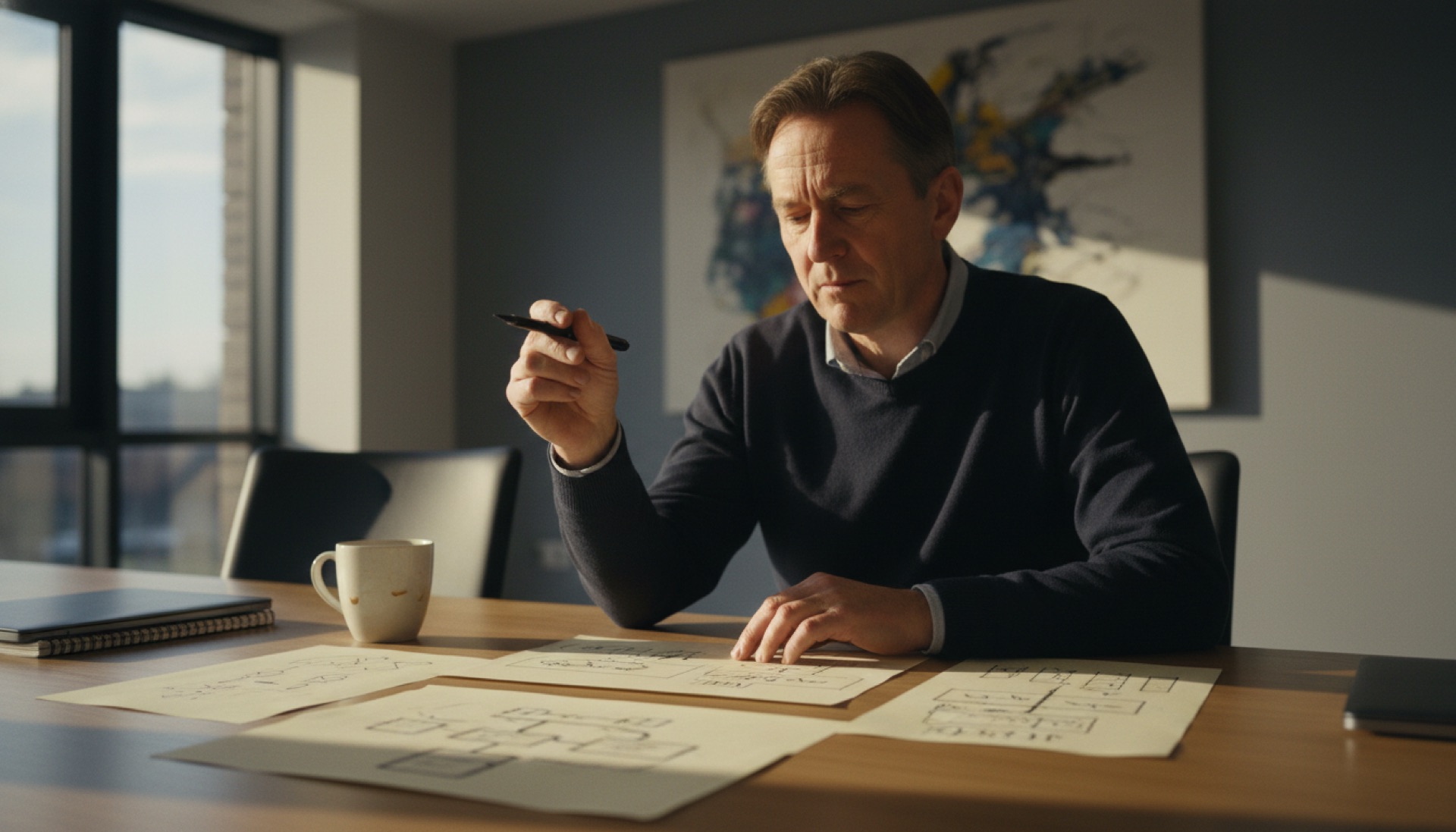
A founder I know was sitting at his kitchen table on a Friday evening, nine months into an AI rollout that had not actually shipped anything. Sixty staff, mid-market services. The senior leadership team had been enthusiastic from the start. The operators on the ground, the people who would actually use the tools, had been visibly enthusiastic. Every fortnight there was a fresh, plausible reason that nothing had moved. Data quality. Team readiness. The next quarter looked better.
He realised, somewhere between the second glass of wine and the end of the working week, that the people in the middle had been running the same play for nine months. Not maliciously. Rationally. They had been running it on purpose, because they were paid to.
Why has the rollout been quiet for nine months?
The answer is almost never the technology. Research on AI pilot failures puts roughly 70% of the reasons in people and process, and 71% of companies cite organisational culture as the top barrier to adoption. Better tooling and longer training will not move that. The silence is a behaviour produced by an incentive structure, sitting two layers below the founder, that is functioning exactly as designed.
Founders consistently misdiagnose this. They assume sharper internal comms or a more polished vendor demo will tip the rollout into motion. The signal they keep getting back is yes-in-principle followed by no-in-practice, and they read it as a communication problem. It is not. The structure is doing what the structure was set up to do.
What is the slow-roll actually for?
It is for survival. 68% of middle managers say they are worried about AI’s effect on their careers, and the typical manager in your firm is measured, formally or informally, on three things, team size, headcount under direct authority and budget owned. An AI rollout that automates routine work reduces all three. Slow-walking is the rational response.
The vocabulary is consistent across firms once you know what to listen for. “We need better data quality first”, “the team isn’t ready”, “let’s pilot next quarter”. Each objection is plausible. The pattern is that the objections refresh rather than resolve. There is rarely a date attached. There are rarely readiness criteria written down. Last quarter’s pilot is still pending.
Once you can name the play, you can see it. And you can stop being annoyed at the people running it. They are behaving rationally given how you have defined their job. The annoyance belongs to the job definition, not to them.
How do you fix the incentive, not the messaging?
You fix it in the document the manager actually reads, which is the review form. “Number of AI-augmented workflows shipped this quarter” needs to be a line on it. “Hours of routine work removed and redeployed to higher-value tasks” needs to be a line. “Yield produced per head” needs to be a line. Each one a real input to promotion and pay decisions, not a slogan on a wall.
Until that happens, the manager is being asked to risk the things they are paid for in exchange for praise at an all-hands. They know that is not a fair trade. So do you, when you stop and think about it from their seat.
The corollary matters. You do not solve this by firing managers, and you do not solve it by removing the management layer. Good management matters more when AI is in the picture, because the manager is now responsible for a mixed team of people and automated workflows, with quality and judgement decisions running across both. The point is that the definition of good has to update. Managing AI agents has to count as real management experience inside your business, on a par with managing people. If it does not, your strongest managers will steer their careers away from anything that involves it.
Why does this have to come from you, not the COO?
Because the level above the people whose incentives are changing is the only level that can credibly change them. A COO asking middle managers to reshape their own role is asking them to volunteer their own diminishment. They will not, and they should not be expected to. A founder making the change is restating the deal. The firm now rewards yield produced, not headcount commanded.
The CEO and AI commentator Daniel Shapiro put it bluntly in his analysis of the firms that have made this transition successfully. It comes from the very top, not the CTO, the CEO. The structural reason is simple. The incentive change has to come from the level that controls the incentives, otherwise it lands as a request rather than a real change.
This is the part founders flinch at, because it sounds like a mandate, and it is. Voluntary middle-out adoption consistently underperforms top-down change in the published research and in every engagement I have seen up close. The mandate is the change. If you will not say it, no one below you can make it real.
What is the conversation to have on Monday?
Not “are you on board with the rollout”. You will get yes. You have been getting yes for nine months. The honest question is closer to this. What will it take to make sure your role is better in twelve months than it is today, when half of what you currently manage is automated? That question changes the conversation from a defence of the current job to a design of the next one.
It also gives you a real answer. Some managers will tell you exactly what they need, a development path into the AI side of the work, a different way of being measured, a credible story they can take home about why the next twelve months are not a slow goodbye. A few will reveal they do not see a next role for themselves in your firm, which is information you needed anyway. The rest will start telling you, in more useful detail than they ever have before, what the rollout actually requires from you.
If you cannot answer that question with them, you do not have a rollout problem. You have a management-design problem, and AI is the tool currently making it visible. Any other change initiative would have surfaced the same wiring eventually. AI is just faster, which is why it is exposing the wiring now rather than in five years.
If you would like a second pair of eyes on where your AI rollout has actually stalled, and what the redesigned management layer in your firm looks like on the other side, book a conversation.