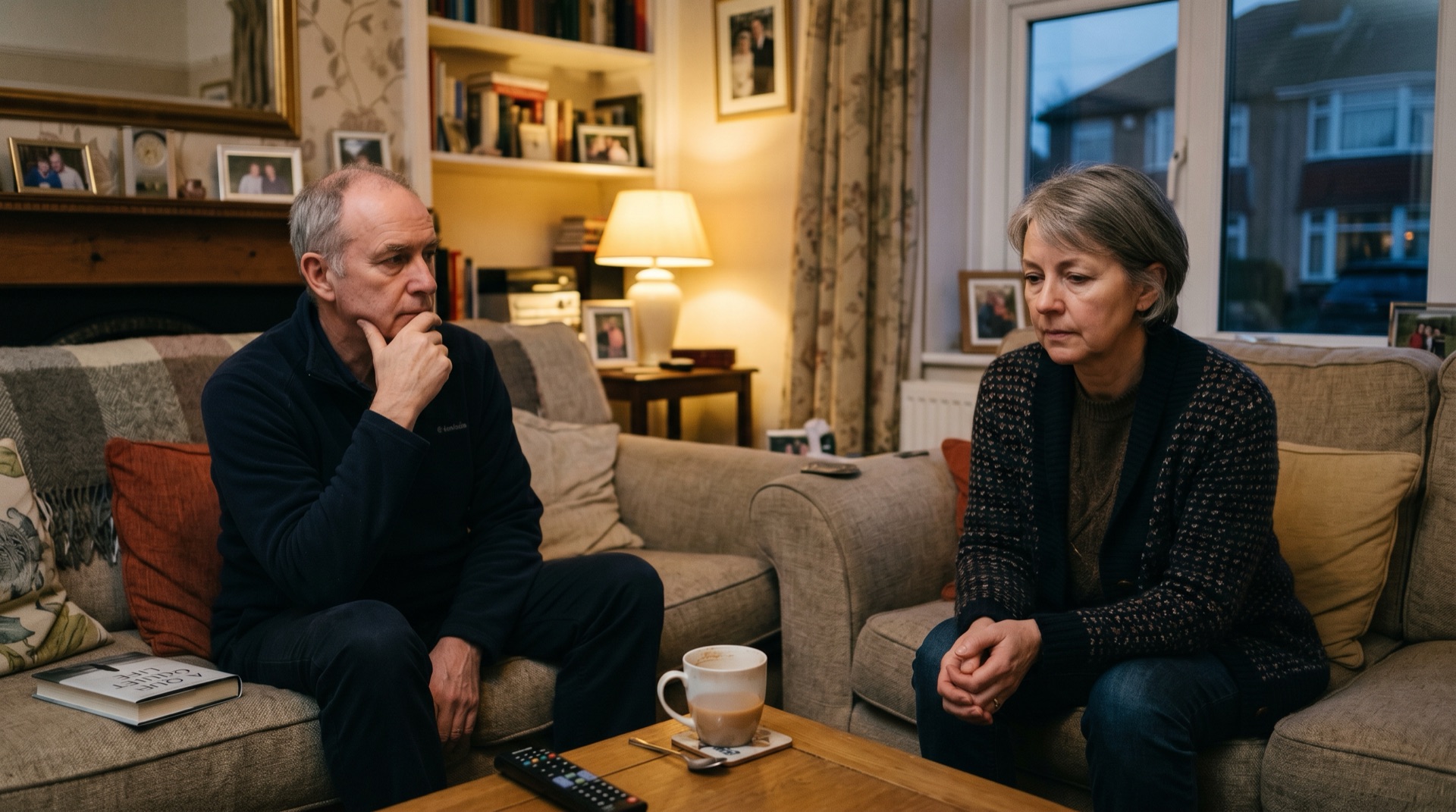
The partner has been holding a question for a while. Quietly, mostly. The relationship has changed in ways neither of them named for years, and they cannot quite tell whether what they are inside is a phase that will pass when the business calms down or whether it is the early shape of an ending. The honest version of the question feels disloyal to ask. The not-asking is its own cost. The partner is here because they want to know what the clinical literature actually says, not what the wellness internet says. They want the structural read.
This piece is the structural read. The marriage in a 60-hour business is a clinical and structural question, and the literature is clearer than many partners expect.
Why is this a structural question, not a romantic one?
The mechanism is not who loves whom or how much. The mechanism is what chronic founder burnout does to a partnership over time, regardless of how the people in it feel about each other. Annie Wright names three specific mechanisms in her clinical writing on founder burnout and divorce, and they operate alongside each other rather than alternately.
The first is presence-without-presence. The founder is physically in the room and psychologically still in the board meeting they left an hour ago. They eat the dinner that was made. They say the right things. They are still solving the problem in their head. The partner has the founder’s body and procedural interactions but not the actual person. One spouse in the clinical literature put it this way. “He’s present but not here. He eats, he sleeps, he says the right things at dinner, but he’s still solving the problem. And I’m invisible to him in the midst of his presence.”
The second is emotional availability collapse. The founder gives empathy, curiosity, responsiveness, and the capacity to receive someone else’s emotional experience to the company, to staff, to investors. They arrive home with very little of those resources left. What looks like indifference is neurobiological depletion, often operating beneath the founder’s conscious awareness. The partner is getting less because there is less to give, not because they matter less. The texture of the loss is identical to the partner either way.
The third is the relationship-as-another-responsibility. Over time, the burnt-out founder begins to experience the partnership itself as a demand on an already-overwhelmed system. The relationship that used to be the source of sustenance becomes another obligation. The partner senses this shift immediately and almost always reads it correctly. It is, clinically, devastating.
What does couple burnout add to the picture?
Couple burnout is a clinical concept distinct from individual burnout, and it shows up in research on partner parentification. The literature describes a chronic imbalance in the distribution of instrumental and emotional responsibilities in adult partnerships, often connected to childhood parentification histories, that produces a particular relational pattern over time, hopelessness and resentment as a feature of the relationship rather than an individual mood.
In a founder partnership, the imbalance is structural in a specific way. The founder is depleted, so the partner picks up the cognitive labour of the household, the emotional labour of monitoring the founder, and the social labour of explaining the founder’s absences to friends, family, and children. That uneven load, sustained for years, produces couple burnout regardless of whether either partner is individually depressed. The partnership is the patient. Treating either partner alone, without addressing the relational imbalance, often does not produce relief, because the system stays out of balance.
This is why couples therapy informed by entrepreneurship matters where it is available. Generic couples therapy can miss the business dimension and treat the relational imbalance as a communication problem rather than as a structural one. Couples therapy that engages with the business as part of the relationship reads the system more accurately.
What about the financial stress nobody is talking about?
Financial silence compounds the relational silence in a way that often goes unnamed. Xero’s 2026 Emotional Tax Return data found that 43 per cent of small business owners hide business-related stress from their family or partner. That number does not reduce the stress. It moves it somewhere else.
The partner often picks up the financial weight in a particular shape. They carry anxiety about whether the household can pay the mortgage this month, while not having full visibility into the business numbers, while also not being willing to ask the founder for that visibility because asking would add to the founder’s burden. The partner is, in effect, carrying both relational anxiety and financial anxiety in private, often without telling the founder, because telling the founder feels like loading them further.
One spouse in the clinical literature put the dynamic this way. “Every month, I don’t know if the business will pay us both. I have a job, but his income is the margin. So I’m carrying not just worry about his mental health but worry about whether we can pay the mortgage. Both things are happening simultaneously, and I can’t really talk to him about the second one because it adds to his burden.” Two layers of cost, both unspoken between people who used to share everything.
Naming the financial dimension explicitly between partners is one of the moves that releases pressure. It does not solve the underlying business problem. It moves the financial weight from one person carrying it alone to two people holding it together. That shift, on its own, often produces a measurable change in the partner’s sleep and stress markers within weeks.
What separates the marriages that recover from the ones that don’t?
The clinical literature is reasonably specific about this, and Annie Wright’s read is the most useful synthesis available publicly. The marriages that fare best, the ones that come through the intensity of founder life with the partnership intact, share three preconditions.
The first is explicit relationship-maintenance agreements made early in the company’s growth, before crisis arrives. Couples who established regular date nights, scheduled phone-free time, and agreed check-ins about the relationship as a working system, before the business reached its peak demands, fare measurably better than couples who treated the relationship as something to be addressed later when things settled down. Wright’s clinical observation, almost verbatim, is that couples who fare best tend to be the ones who created explicit agreements about relationship maintenance early in the company’s growth, rather than treating the relationship as something that could be addressed later when things settled down.
The second is individual founder work alongside couples work. The founder going alone into therapy without the couple work often produces individual recovery that does not translate into relationship repair. The couple going into couples therapy without the founder doing individual work often produces communication improvements that do not address the underlying identity-fusion driving the burnout. Both layers, addressed in parallel, produce the change. One layer alone is rarely enough.
The third is the cost named together rather than carried in private. The partner who has been carrying the observation, the financial worry, the relational grief, in silence, is the partner most likely to arrive at the divorce conversation feeling that the marriage already ended years ago without anyone saying so. The partner who named the cost as it accumulated, even imperfectly, even with conversations that went sideways, is the partner most likely to arrive at the recovery conversation with something to work with.
What is the cost when this path runs out?
The divorce literature is unsentimental. The mental health of divorcees is significantly worse than population norms, with Cohen’s d effect sizes of 1.38 for men and 1.29 for women, indicating substantial and clinically meaningful deterioration. Translating that into ordinary terms, divorce after a long founder partnership has documented mental health costs that are large and lasting. That is an argument for not arriving at the divorce conversation by accident, through accumulating not-said-things, when the conversation that might have repaired the marriage was structurally available and never had. Staying when staying is wrong is a different question entirely.
Some marriages do not recover. That is the honest read. The mechanisms have run too long. The unspoken cost has hardened. The window for the work has closed. This piece is for the partner at any stage of the question, including the partner who is grieving rather than rebuilding. Naming the mechanisms is useful regardless of which stage you are reading from.
If you are at the rebuilding stage and would like to talk through what the structural work might look like in your specific situation, book a conversation. The marriage is the system that gets missed when founder coaching is treated as an individual project. Reading it as a clinical and structural question is what makes the work coherent.