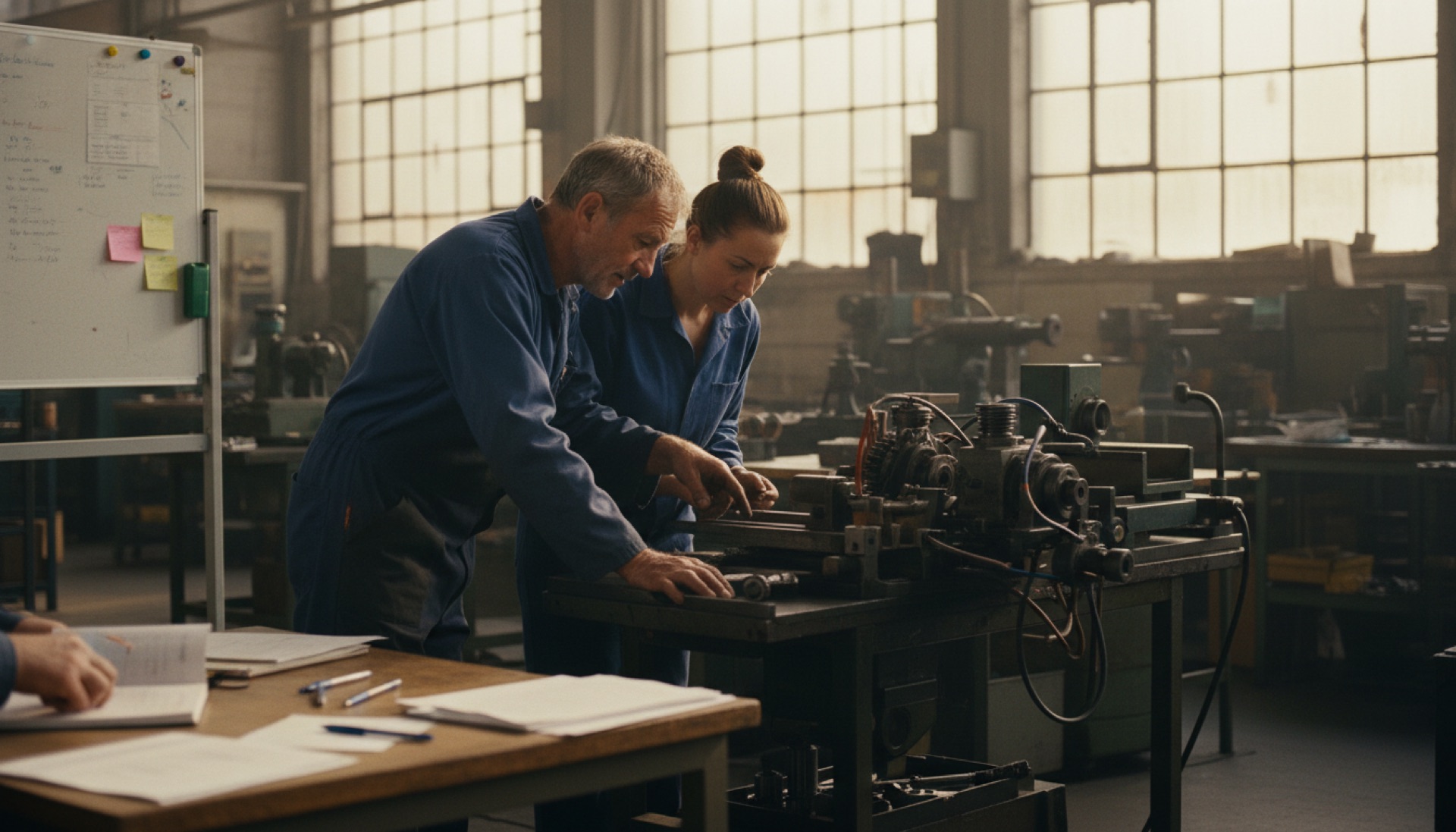
Three of your most knowledgeable operators are within a few years of retirement. Between them, they hold several decades of working knowledge about how the machines behave on certain days, why a specific batch fails at the third stage, and what a particular long-standing customer actually means when they say the specification is fine as it is. Almost none of it is written down. This is not unusual in specialist manufacturing. It is the norm. And it is one of the highest-risk gaps in the operation.
What is shop-floor knowledge capture?
Shop-floor knowledge capture means recording the informal expertise your senior operators carry, then making it searchable by everyone else. That covers machine-specific adjustments no one thought to document, the diagnostic logic behind a batch failure, the pattern recognition built over decades on the same process. AI makes this practical in a way that traditional documentation never did, with semantic search that responds to a plain-English question from any team member.
The traditional approach was the standard operating procedure, a document describing the planned process in planned conditions. Those documents matter. But they rarely capture what happens when conditions drift, when the equipment behaves unexpectedly, or when a customer’s specification needs interpreting rather than following literally. The experienced operator bridges those gaps intuitively. A knowledge base built with AI is an attempt to make that bridging logic explicit and persistent, so the business holds it rather than one person holding it for the business.
Why does this matter more in specialist manufacturing?
Specialist manufacturing concentrates expertise in a small number of people who have spent years on the same processes, the same equipment, and the same customers. The workforce across skilled trades and manufacturing is ageing. When BuildOps surveyed commercial contractors, 80 per cent said AI would be essential within three years, and institutional knowledge becoming scarcer was the reason cited most often. You cannot hire that experience in.
The British Chambers of Commerce found that half of UK businesses have started using AI, but the headline number masks a significant data quality problem underneath. Owner-managed manufacturers at this scale typically have fragmented IT systems, inconsistent records, and very little of their most valuable knowledge in any structured form. The ageing workforce problem adds to the urgency. The people who know the most are also the least likely to use digital systems, which makes capture a time-sensitive manual effort rather than an automated one.
The OECD’s 2025 research on AI adoption by owner-managed businesses flagged a widening gap between larger firms, which can afford dedicated teams to document and systematise knowledge, and smaller ones, where that work falls to whoever is least busy. In a 70-person manufacturer, the gap between knowing you need to capture something and actually doing it can stretch for years. By then, one of the people whose knowledge you needed has retired, and the window has closed.
Where does the high-risk knowledge actually live?
The highest-risk knowledge in a specialist manufacturer sits where standard documents stop. It lives in the machine-specific adjustments that experienced operators make without thinking, the diagnostic reasoning they apply when a batch behaves unexpectedly, and the interpretive layer between what a long-standing customer says and what they actually mean. These were not documented because at the time they developed, nobody thought of them as knowledge. They were just what experienced people did.
A practical way to identify this knowledge is to ask a single question for each person approaching retirement. If they left tomorrow, where would the first problem appear? The answer usually points to a specific process, a specific customer, or a specific piece of equipment. That is where to start. Map those single points of failure, rank them by the likelihood and timing of departure, and you have a capture priority list. Capture what would hurt most if it walked out the door. The rest can follow once the highest-risk gaps are covered.
That mapping conversation can itself surface material worth preserving. Ask senior operators to describe the last three problems they solved that a less experienced colleague could not have solved alone. The answers rarely point to textbook procedures. They point to machine history, to previous failures, to customer-specific quirks built up over years of working with the same account. Those conversations, recorded and indexed, are the raw material. A capture programme does not have to start with software. It can start with a voice recorder and two hours of an experienced person’s time.
When does this beat a production-line AI project?
A delegate handed an AI mandate is often expected to deliver something visible, a predictive maintenance model or an automated inspection system the founder can point to. Knowledge capture looks less dramatic. But it pays back in 6 to 12 weeks, well ahead of production-line AI projects that typically run 12 to 18 months before touching the operation, and which depend on clean machine data many specialist manufacturers do not yet have in a usable state.
Research on knowledge management systems shows organisations reduce knowledge retrieval time from 15 to 45 minutes to 2 to 5 minutes, and report a 40 to 60 per cent increase in the reuse of existing organisational knowledge. In a manufacturing environment, that means a less experienced operator can find an answer and solve a problem within a shift, rather than waiting until the right person is next in the building. The case for production-line AI is real, but it is a second-phase project. Knowledge capture is the move that protects the business while the data and budget for phase two are being built.
What does a first knowledge capture programme look like?
A realistic first programme for a specialist manufacturer of 50 to 100 people takes eight to twelve weeks across three phases. The first phase identifies who holds knowledge with no backup, ranked by proximity to retirement. The second phase captures it through structured interview sessions, recorded and transcribed, then organised into a searchable knowledge base. The third phase deploys a semantic search layer so any team member can query the knowledge in plain English without needing to know where to look.
Tools at this scale range from Notion AI or Microsoft SharePoint with AI search to dedicated knowledge management platforms such as Glean. Total cost typically falls between £50 and £500 a month depending on firm size and platform. The most important consideration is governance, not technology. A knowledge base that nobody maintains goes stale within six months and staff stop trusting it. Assigning one person to own the knowledge base, with a quarterly review built into their role, costs very little and determines whether the system remains useful for years or becomes another abandoned folder on the server.
The case for starting here comes down to timing. Gallup’s research on AI adoption found that only around one in ten employees in AI-adopting organisations strongly agree that AI has reshaped how work gets done. Knowledge capture is not about reshaping anything. It is about preserving something the business already has, something that exists in a small number of people right now and will not exist at all once they leave. The production-line investment can be planned once the data exists. The knowledge your three most experienced operators carry cannot be recreated after the fact.