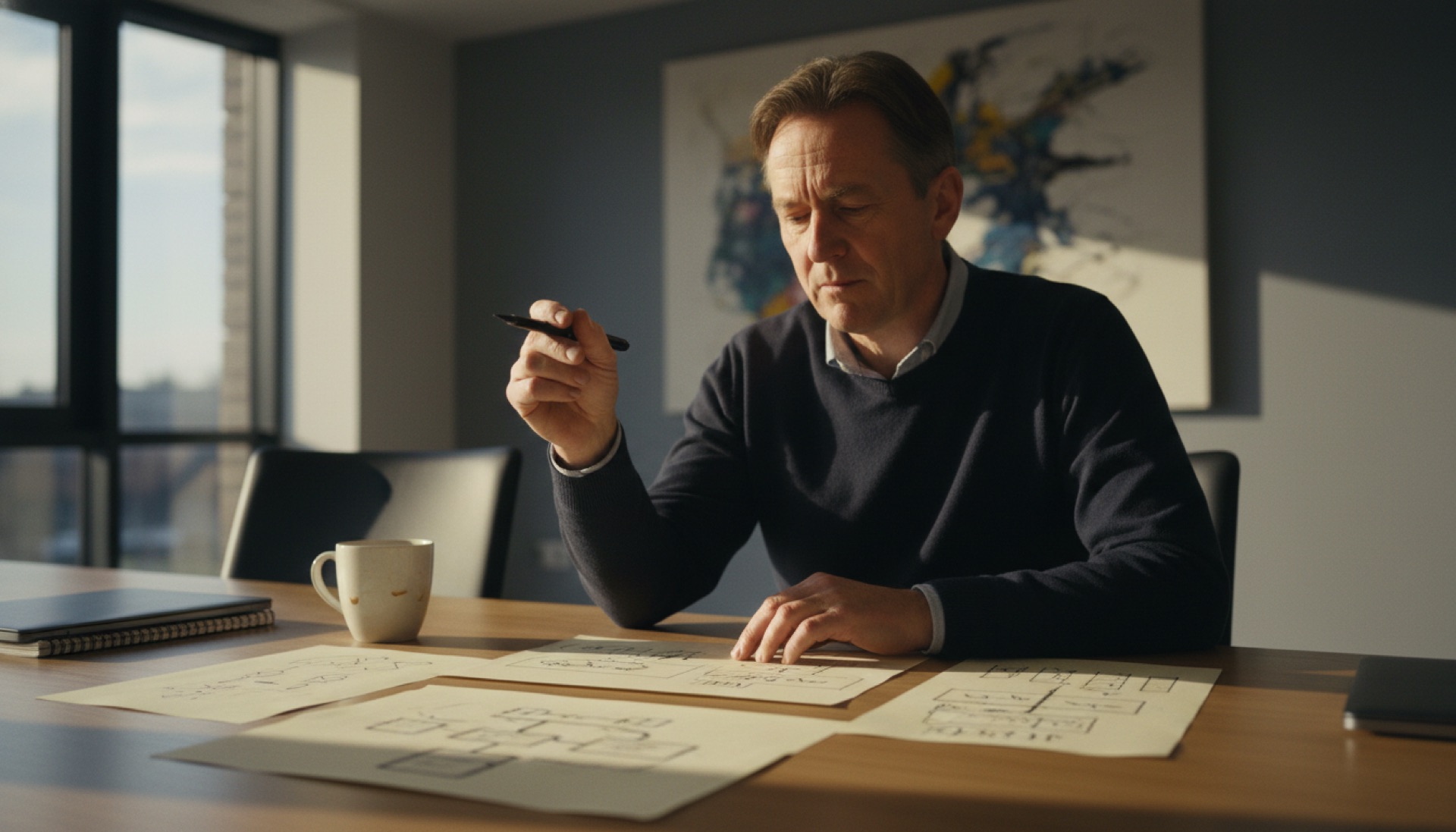
The researcher at a £3m UK services firm has just finished a ten-participant interview cycle. Forty to sixty hours of post-interview analysis sit in front of her. The design lead has three competing wireframe directions and four weeks to validate one of them with users. The MD has £10,000 of tooling budget and wants the next product cycle in eight weeks rather than twelve.
The five-person product team (head of product, two designers, one researcher, one product analyst) is already running. She is past the question of whether AI belongs in product work. The live question is which single bottleneck to compress first, and where the boundary sits with the firm’s accessibility commitments and brand voice.
A competitor’s product lead has just posted on LinkedIn about running three research cycles in the time the firm used to run one. The MD has forwarded the post and asked, with reasonable directness, why this firm isn’t doing the same. This post answers that directly. If you are still mapping where to start across functions more broadly, where to apply AI first is the precursor to this one.
What jobs does AI actually do well in product and research today?
Five jobs are deployable now with quantified evidence. User research synthesis and theme extraction. Unmoderated testing and task-completion analysis. Design generation from text specifications. Competitive and market research acceleration. Multilingual transcript synthesis across regional customer bases. Each has named UK-priced tooling and at least one documented mid-market deployment behind it.
Research synthesis is the best-evidenced category. A UK management consulting firm using Dovetail compressed post-research analysis from forty hours per ten-participant study to roughly eight, and shifted from two research cycles per quarter to three or four. Looppanel handles the multilingual case. A martech firm serving the UK, Germany and Scandinavia ran a sixteen-participant study across three languages and turned what was three to four weeks of manual coding into about six hours of product-team analysis time.
Unmoderated testing has changed the cost model. Maze drops cost per participant from £75 to £150 (moderated) to £30 to £50, and shrinks the cycle from three to four weeks per test to three to five days. One UK fintech ran four unmoderated tests inside a twelve-week discovery for around £500 a test, replacing what would historically have been one moderated cycle.
Where are the leaders actually using it?
The named-precedent map is narrower than the brochure landscape. For research synthesis, Dovetail (research repository plus AI tagging, Zoom and Calendly integrations) and Looppanel (multilingual transcript synthesis with Zoom integration) are the two with the deepest UK SME footprint at £50 to £150 a month. For unmoderated testing, Maze (Figma-embedded) and Sprig (in-product research with AI insight generation) are the working pair at £150 to £300 a month.
For design generation from text, three names recur. Figma Make for text-to-wireframe inside an existing Figma workspace. Framer AI for production-grade landing pages from natural language. v0 by Vercel for React and Tailwind code from text or sketch. A £2.5m UK SaaS compliance firm used Figma Make to produce three role-specific wireframes in three days against a six-to-eight-week historical pattern.
Around those, three secondary names earn a mention. Cursor as the AI-assisted IDE that picks up the engineering side of the design-to-code handoff. Lovable.dev for non-technical founders building MVPs. Perplexity Pro at £20 per user per month for competitive and market research, with Deep Research citing sources so the work is checkable. ChatPRD sits at the documentation layer for product requirement drafting.
Where does AI fall short in product and research?
Five boundaries the brochure omits. Generic UI output from Figma Make, v0 and Framer AI uses default spacing, palettes and typography, so brand alignment runs four to eight hours of designer refinement per component set with no learning across iterations. Accessibility gaps in AI-generated code routinely include missing ARIA labels, non-semantic HTML and inadequate contrast against WCAG 2.1 AA, adding two to four hours of audit per output.
Bias amplification on small samples is the costliest failure mode to miss. A fintech product team using Dovetail’s synthesis layer nearly shipped a “users prefer single-step onboarding” feature based on six interviews. The raw video showed four of the six participants explicitly wanted longer, visually engaging onboarding. The AI had smoothed over the disagreement on keyword frequency. Returning to source is a discipline, and it is the discipline that turns AI synthesis from a risk into a force multiplier.
Brand-voice drift in generated UI copy and PRD prose typically consumes 40 to 60 percent of the time saved on generation, so firms without a documented brand glossary lose more than they gain on content output. IP and training-data ambiguity bites on v0-generated code that may resemble open-source patterns. Under UK law the directing party owns the output, but if training data included copyrighted work and output resembles it, exposure exists. Audit trails of inputs and outputs, plus vendor indemnification clauses at procurement, are the practical mitigation.
What does a 90-day starter rollout actually look like?
Three phases for a five-person UK product team. Weeks one to three cost £4,000 to £6,000 in tools and staff time. Pick one bottleneck, ideally research synthesis on a six-to-twelve-hour archive of past sessions; trial Dovetail or Looppanel for one week; configure a parallel Maze trial on a current design problem. The phase-one success metric is governance plus one documented pilot, not headline performance lift.
Weeks four to eight (£3,000 to £5,000 in tools, £4,000 to £6,000 in staff time) scales the chosen synthesis tool to all new research, standardises the tagging taxonomy and saved-query library, and integrates Maze into the design review process. A second concurrent pilot runs on a low-risk discrete design problem. Deliverable is one full research-to-design cycle using AI synthesis plus one complete unmoderated test, with the new workflow documented.
Weeks nine to twelve (£2,000 to £3,000 incremental tools, £4,000 to £6,000 staff time) bring Figma Make or v0 onto a discrete design task, Perplexity Pro for one to three users on competitive research, and a quality-control checklist (raw-video review for synthesis claims, WCAG 2.1 AA audit on generated UIs, brand audit on generated copy). Total 90-day cost lands at £11,500 to £17,000, roughly the price of one full moderated research cycle, with every cycle for the rest of the year compressed.
What should you ask before you commit?
Five procurement questions cover the territory. On participant consent, check whether the recording consent flow is specific, prior to recording, and granular per use (research, training, marketing). ICO guidance is explicit that bundled consent does not satisfy UK GDPR. On data subject rights under the Data Use and Access Act 2025 in force February 2026, check whether the platform can support access, deletion and portability requests within thirty days, with documented bulk export to JSON or CSV.
On accessibility, check whether the platform exposes any built-in WCAG audit, or whether you need to budget two to four hours of designer audit per AI output. The current generation of design-generation tools sits firmly in the second camp, so the question is whether your team has that capacity, not whether the tool will provide it. The Equality Act 2010 is the legal anchor in private-sector procurement; WCAG 2.1 AA is the working baseline.
On synthesis quality, check whether the tool surfaces contradictory evidence rather than smoothing it, and whether it warns at sub-ten-participant samples. Test with a known-contradictory archive before signing. On IP indemnification for AI-generated code, particularly v0 output, check whether copyright protections are written into the contract rather than promised in the sales call. The deeper procurement frame, including how AI in product work intersects with operational maturity, is in AI as your operational integrator. If you’d like to sense-check your own slice of this, book a conversation.